I've got an Irish name and a stack of Irish books, and I studied Irish (history, literature and language) in college, so let me tell you: this is my holiday. Not in the green beer, car bomb (please think about car bombs in the context of Irish history and then think about not calling them that anymore), get-wasted kind of way, but in the celebrate Irish heritage and Irish literature and Irish food kind of way. I'm planning a lunch with Dubliner cheese (it's a thing, it's at Costco, and it's divinely zingy cheddar), dinner with potatoes (and yes, let's be honest, probably Jameson) and you know I'll be stocking up on super-sale corned beef and cabbage tomorrow. One for the slow cooker, one (maybe two) for the freezer.
I've written before about some timely Irish-themed reading in honor of the holiday. It's impossible to consider Irish lit without considering Joyce, of course; though I haven't read (and am not sure I will read) Ulysses, Dubliners remains one of my favorite short story collections. I first read it in college and have a slim, lime green copy I may revisit this week.
Showing posts with label comics. Show all posts
Dipping Into Comics: The Story of a Newb
09 January 2015
I'm a comic newbie*. Until the last few months, I found
comics--and, by extension, graphic novels--a completely foreign entity,
something I either wasn't interested in or wasn't capable of understanding. The
comics world seemed tight-knit, exclusionary, full of insider baseball, and to
an outsider like me, it was impossible to tell where to start. Or why I'd even
want to.
That's not to say I'd never read a comic before coming to this
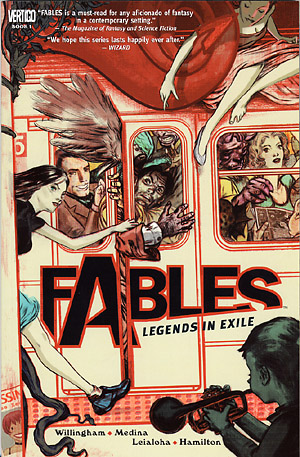
conclusion: I read (and adored) Bill Willingham's stunningly imaginative Fables
series years ago. Someone along the line had also pressed Watchmen, that much-loved
classic of comics, into my hands, and I devoured it in just a few days. I even
volunteered at the Titan Books booth at New York Comic Con and got to a) go to
NYCC and b) meet Dave Gibbons (and have him sign my copy of Watchmen).
But somehow, those felt like exceptions to a rule rather than the
start of something new.
Over the last year, though, comics have started to issue a siren
song I've found impossible to ignore. I discovered that my local library
carries the Saga series,
and I moved from the first three trade volumes of that to Brian K. Vaughan's
other two series: Y: The Last
Man and Ex Machina.
I tried Rat Queens (which
I didn't love as much as the rest of the internet) and read all six volumes of Sweet Tooth in one morning
(I cried at the end).
What this new-to-me dive into comics has taught me, though, is not
just that there are some epically wonderful series in the comics world. It's
that my entire concept of comics was wrong:
The Comics Culture
Comics people are not exclusionary. With very few exceptions, I
have found that what I once took to be clique-like and full of insider baseball
is actually just a series of rare and enviable instances of a community of
people finding "their people." And this community is always looking
for--and willing to help indoctrinate--new members.
The staff at my local comics, for example: pretty freaking
awesome. Awesome and willing to spend 15 minutes walking you (me) through the
store to find just the right new series based on the limited experience you've
had so far. They know their stuff, but they don't lord their knowledge over
you: that knowledge is there for the sharing.
Comics Change the Way You Read
You have to learn to read the pictures. I've gotten better at this, though I admit I still finding
myself reading only the dialogue in a desperate attempt to find out what happens, and
thereby realize I've missed the incredible artwork on the page. Reading comics
has taught me to read more slowly, and to savor the page. I've also found the
urge to re-read--something I do occasionally with my most favorite of novels
and non-fiction books, but not often--is ten times more prominent in my comics
reading: once I know what happens, I want to go back and revel in the beauty of
each page.
You have to learn to appreciate a story in small episodes. Whether you read individual issues or trade volumes, comics
come in episodes. I'm used to reading multiple books at one time, so the idea of enjoying multiple
series--and therefore multiple storylines--in one time period, albeit over the
course of several weeks or months, is not foreign to me. It’s still not easy,
but learning to appreciate this style of reading is enjoyable in and of itself.
It’s OK to Admit What You
Don’t Know
I don’t know all the most famous, most iconic, most important
comic series in history.
I don’t know how to set up a pull list. I only vaguely know what a
pull list is.
I don’t know if I like reading individual issues, or if I will
continue to read all trade editions.
I don’t know what other series I should be reading.
I don’t even know what else I don’t know.
And that’s ok. Because comics (and reading in general, I’d argue),
are about more than being an expert in something.
They’re about being an expert in trying new things, experimenting with new
ideas and formats and approaches and styles and art and beauty and
what-have-you, and going into it all with an open mind.
---
*Newbie as in new-to-something, not to be confused with noob/n00b/noobie, which I've learned has a slightly different meaning (and definitely different connotation).
---
Fables | Created by Bill Willingham | 2002 - present | Vertigo
Watchmen | Written by Alan Moore, Illustrated by Dave Gibbons | 1986-1987 | DC Comics
Saga | Created by Brian K. Vaughan and Fiona Staples | 2012 - present | Image Comics
Y: The Last Man | Written by Brian K. Vaughan | 2002 - 2008 | Vertigo
Ex Machina | Written by Brian K. Vaughan | 2004 - 2010 | DC Comics
Rat Queens | Written by Kurtis J. Wiebe | 2013 - present | Image Comics
Sweet Tooth | Created by Jeff Lemire | 2009 - 2013 | Vertigo
European Adventures: Dublin, Ireland | Dublin Castle, St. Stephen's Green, a Literary Pub Tour
29 October 2014
Another day in Dublin, another day of siteseeing: Dublin Castle, which is a surprisingly mismatched collection of old medieval walls, an early 19th-century church, medieval foundations, and staterooms that have hosted everything from Taioseach speeches to JFK visits. And then, in case that didn't hold enough Dublin history in one place, we ventured over to St. Stephen's Green, where I promptly started reading Joyce's Dubliners, because how could I not?
Oh, yeah, and we went on a literary pub tour. Because beer + books = best.
Dublin Castle
![]() |
| The only remaining tower from Dublin's original medieval city walls. It's now a police museum. |
![]() |
| Old medieval walls pressed up again modern buildings... a thing about Europe that will never cease to surprise me. |
![]() |
| This carriage wall was actually built in the mid-19th century, but designed to look like part of the medieval castle. Note: That green is not retouched. It's really that shade of green. |
![]() |
| The Chester Beatty Library, because: free library with exhibits on the history of books. Duh. |
![]() |
| One of the "new" wings of Dublin Castle, from the courtyard. |
![]() |
| My uniform for all of our stay in Ireland: hiking/walking shoes, raincoat, jeans, sweater, bun on top of my head (none of our apartment rentals had a hair dryer...), Strand tote bag. |
![]() |
| The kinds of photos one finds on one's camera when one lets one's husband use the camera. |
St. Stephen's Green
You know how you hear about how green Ireland is? Well, yeah. Those rumors are true. (Even more true in the countryside, but even Dublin is remarkably green.)
![]() |
| The husband and his authorly idol. |
![]() |
| Quite possibly the best sandwich I have ever, ever eaten. That bread is called a blaa (not a typo), and I am making it my life mission to learn how to make it. |
![]() |
| Because it's not self-explanatory: The Famine Memorial. |
![]() |
| Seriously, those colors though. |
![]() |
| No really. That ivy. Believe you me this is what had me breaking out Dubliners as soon as we got back to our apartment. |
Literary Pub Tour
I'll admit I didn't take many pictures on this tour (too busy drinking beers and soaking in the literary trivia), but if you ever find yourself in Dublin, I can't recommend this pair enough.
![]() |
| Trinity College at dusk. |
Peter & Max - a Fables Novel
24 September 2009

Thanks to Jay Franco, I once again find myself feeding my Fables addiction; this time, it's Peter & Max, the first Fables novel by Bill Willingham.
For those of you who haven't read the Fables books (and you should, immediately), the series tracks the stories of various fabled characters - Snow White, Cinderella, the 3 Little Pigs, Pinnocchio, et al - and their flight from their homelands in face of an unknown invader. They set up a hidden community in New York City... and I can't really tell you any more than that without spoiling it.
Bill Willingham's genius for creating stories out of pre-existing plots and details rivals that of Gregory Maguire, author of Wicked, et al, and his latest installment in the Fables series does not disappoint in this regard. Peter and Max tells the story of the Pipers: Peter Piper (of pickled pepper fame), and Max (of the Pied Piper legends). Willingham's character development can be a bit uneven - perhaps he should have titled the book PETER and max - but this does not detract from the plot overall. Willingham's story moves steadily through modern and magical times, drawing together several fable strings into one cohesive story that is quite hard to put down.
Bottom line: A quick read, Peter and Max will entertain both the Fables fanatics and novice reader alike, and contains enough inked illustrations throughout to satisfy the graphic-novel-nerd in all of us. Especially enjoyable for the reader with a knowledge of fables and folk tales.
Fables
26 September 2008
Graphic novels spell nerdy, right? Wrong. Although I did take some flak for devouring the Fables series (albeit from a lvl-70 WoW player, who was very much the pot in this pot and kettle situation), it wasn't really something I could stop once I started. And now that I've just finished The Good Prince, I'm already dying for #11. Too bad they haven't written that one yet.
To put it briefly: Bill Willingham is a genius.
To elaborate: he's created a world of fable characters (yes, all of them) that live in an enclave in New York City after fleeing their respective homelands (they don't all live in Happily Ever After, after all) as they were taken over by an unknown conqueror. The non-human fables (i.e. the Three Little Pigs) can't live unnoticed in the city (I'd question that concept, as there are some pretty strange characters around here that do look like they walked out of a fable) live on a farm upstate.
Each new character in the books is a chance to place that name to the story it has come from. Some are obvious (Snow White and Prince Charming, for example), some slightly trickier (Bigby Wolf) and some I still haven't placed (Baba Yaga, anyone?). Willingham cleverly twists the very nature of fables to his own use; the invincibility of a fable, for example, is directly related to the popularity of his or her story. The more popular the story, the harder it is to kill its characters. He also answers some questions that I'm sure have bothered many a questioning child. How could Prince Charming be in so many stories? What does "happily ever after" really mean? Prince Charming has three ex-wives and Beauty and the Beast are still married but sick of each other—does that help answer your question?
Willingham takes his characters throughout centuries of world history: Bigby Wolf was a Special Ops leader in World War II, Jack Horner fought on both sides of the Civil War, Hansel led the crusade against witches in Salem. Clearly, these fables have been living here with us for quite some time, and, when necessary, or when they feel like it, they have intervened in the lives of us mundane humans. But they also have their own battles to fight...
I'll leave it at that lest I spoil any more. Thanks to Jay for lending me the books all summer. You can preview the first part of the first book here.
To put it briefly: Bill Willingham is a genius.To elaborate: he's created a world of fable characters (yes, all of them) that live in an enclave in New York City after fleeing their respective homelands (they don't all live in Happily Ever After, after all) as they were taken over by an unknown conqueror. The non-human fables (i.e. the Three Little Pigs) can't live unnoticed in the city (I'd question that concept, as there are some pretty strange characters around here that do look like they walked out of a fable) live on a farm upstate.
Each new character in the books is a chance to place that name to the story it has come from. Some are obvious (Snow White and Prince Charming, for example), some slightly trickier (Bigby Wolf) and some I still haven't placed (Baba Yaga, anyone?). Willingham cleverly twists the very nature of fables to his own use; the invincibility of a fable, for example, is directly related to the popularity of his or her story. The more popular the story, the harder it is to kill its characters. He also answers some questions that I'm sure have bothered many a questioning child. How could Prince Charming be in so many stories? What does "happily ever after" really mean? Prince Charming has three ex-wives and Beauty and the Beast are still married but sick of each other—does that help answer your question?
Willingham takes his characters throughout centuries of world history: Bigby Wolf was a Special Ops leader in World War II, Jack Horner fought on both sides of the Civil War, Hansel led the crusade against witches in Salem. Clearly, these fables have been living here with us for quite some time, and, when necessary, or when they feel like it, they have intervened in the lives of us mundane humans. But they also have their own battles to fight...
I'll leave it at that lest I spoil any more. Thanks to Jay for lending me the books all summer. You can preview the first part of the first book here.
Subscribe to:
Posts (Atom)