It's Book Blogger Appreciation Week! Hosted by Ana, Jenny, Heather, and Andi, the week is designed to "celebrate the hard work, dedication, and love we all put into this adventure we call book blogging." Check back throughout the week for posts on the joys of blogging, discovering other bloggers, and more!
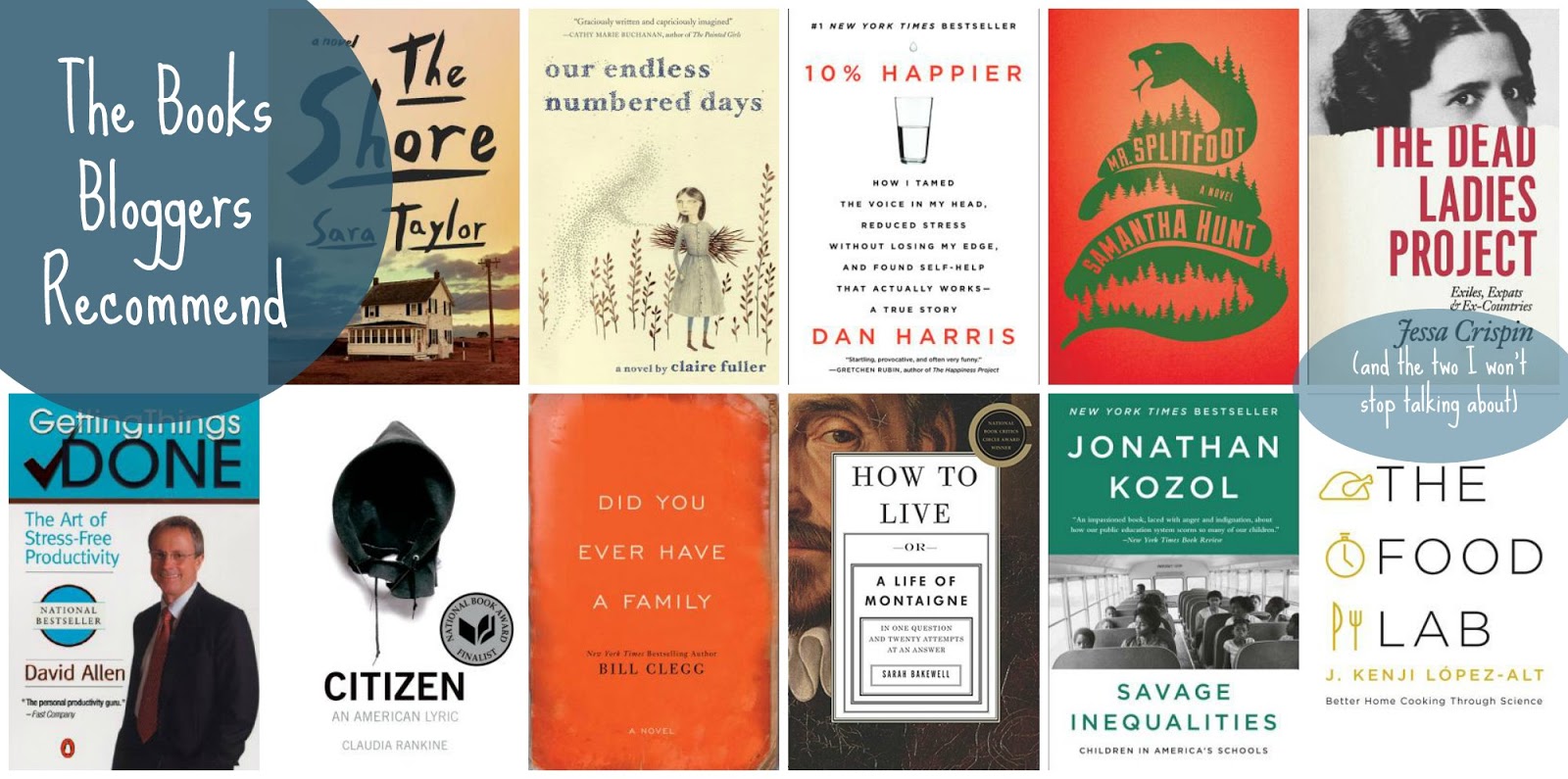
Today's prompt is all about book recommendations... the books we've read (or, in the case of some of the below, plan to read) because other bloggers have pushed them in our hands and the books we've pushed into others' hands.
Showing posts with label reviewing. Show all posts
Writing About Reading
17 April 2015
How do you write about your experience as a reader with authenticity, when one's experience as a reader is intensely personal?
I spend the large majority of my not-work, not-sleep time either reading or writing about reading (or thinking about reading or thinking about writing about reading). This question is personal to me, especially as one prone to question my right to review books and my place in this bookish community. When I talk about books, I am very conscious of the fact that reading is inherently personal; it is by looking at that personal experience in the context of the larger world--of readers, of writers, of stories--that my experience with a book feels valid and worth sharing.
Getting It Wrong: When It Takes Time to Appreciate a Book
26 June 2014
I am here to admit that I was wrong. Two years ago, when I reviewed The Leftovers, I found myself believing--believing strongly enough to write it down on the internet--that the book did not live up to its full potential. That while it had quiet moments of brilliance, those moments did not add up to something that, overall, was meaningful to me.Two years later, I'm still thinking about that damn book. Unbidden, it pops into my head. Around the time when certain peoples kept predicting the rapture, I kept thinking about The Leftovers, and the insane, unconsidered consequences that disappearance can have. When three kidnapped girls emerged from Ariel Castor's basement after over a decade in captivity, I thought again of The Leftovers, of the struggle of the girls' families as they fought to cope with something that could never be explained. When I started reading Y: The Last Man, I again went back to The Leftovers, wondering how Perrotta's story might have differed if the disappearances had been consolidated to a specific trait: gender, as in Vaughn's series, or race, or religion, or belief, or geography, or any other characteristic.
I've long said that what I look for most in a book, any book, is its power to live on beyond the last page. Fiction or non, realism or fantasy, it doesn't matter: books make us think, make us reconsider our world and our lives, make us bigger than we were before we read them.
The Leftovers did just that. It just took two years for me to realize it, and the impetus of the upcoming HBO show to crystallize these thoughts. I was wrong, and I couldn't be happier about it. And I also can't wait for the series adaptation.
Have you ever gotten it wrong in your thoughts about a book? Which book?
Getting it Wrong
19 July 2012
We all know that authors responding to reviews -- especially negative reviews -- can be a dangerous thing. But what if the review is just... wrong? What if the reviewer messed up?
That's exactly what happened in the New York Times review of Patrick Somerville's latest novel, This Bright River, titled "Unmoored and Meandering: Two Twigs Swirl in the Eddies of Lifes' Stream." The title just about sums up the review; in short, the reviewer didn't like it. At some point, the adjective "soggy" is used--and adjective I'm still struggling to figure out how to apply to writing.
But this is not merely a question of a good review versus a bad review--this is a question about a right review versus a wrong review. Because, it seems, the reviewer for the New York Times got it wrong.
Apparently, the opening sequence of the book leaves the answer to the question, "Who got hit on the head?" a little ambiguous. The New York Times reviewer filled in the blanks... incorrectly. And then reviewed the book. And hated it. But what if she had figured it out correctly? What if she hadn't missed that one crucial distinction between one character and the other?
We all know how one thing can spiral a book into a land of dislike: a particularly unbelievable character; a shoddy timeline of events; the world's most awkward dialogue. Often, as a reader, I have a hard time re-immersing myself in a story when I have been abruptly pulled out by some piece of poor writing. But what if, as in the case of The Bright River, it isn't actually poor writing--it's just my own oversight?
I have to admit, this is one of my biggest fears when writing about books. What if I get it wrong? What if I misinterpret what the author meant? What if I read into something that isn't there, or fail to grasp some key element?
There are those that would argue that a book should stand on its own, apart from author intent; it shouldn't matter what the author meant, only what the author said. I agree with that, but I'm not talking about mere interpretation. I'm talking about instances of confusing two characters, as in the New York Times review, or the possibility of glossing over or simply forgetting some detail that is crucial to the ultimate success of a story. That strikes me as outside the author's control--but fully within the reviewer's.
For the record, the New York Times did eventually print a correction; Somerville wrote about the entire experience in this Salon piece. And to be honest, I'll bet Somerville is getting more interest in his book because of the flub than negative interest because of the poor review. Bad reviews happen all the time; mistaken reviews, we're led to believe, are less common. Or are they?
That's exactly what happened in the New York Times review of Patrick Somerville's latest novel, This Bright River, titled "Unmoored and Meandering: Two Twigs Swirl in the Eddies of Lifes' Stream." The title just about sums up the review; in short, the reviewer didn't like it. At some point, the adjective "soggy" is used--and adjective I'm still struggling to figure out how to apply to writing.
But this is not merely a question of a good review versus a bad review--this is a question about a right review versus a wrong review. Because, it seems, the reviewer for the New York Times got it wrong.
Apparently, the opening sequence of the book leaves the answer to the question, "Who got hit on the head?" a little ambiguous. The New York Times reviewer filled in the blanks... incorrectly. And then reviewed the book. And hated it. But what if she had figured it out correctly? What if she hadn't missed that one crucial distinction between one character and the other?
We all know how one thing can spiral a book into a land of dislike: a particularly unbelievable character; a shoddy timeline of events; the world's most awkward dialogue. Often, as a reader, I have a hard time re-immersing myself in a story when I have been abruptly pulled out by some piece of poor writing. But what if, as in the case of The Bright River, it isn't actually poor writing--it's just my own oversight?
I have to admit, this is one of my biggest fears when writing about books. What if I get it wrong? What if I misinterpret what the author meant? What if I read into something that isn't there, or fail to grasp some key element?
There are those that would argue that a book should stand on its own, apart from author intent; it shouldn't matter what the author meant, only what the author said. I agree with that, but I'm not talking about mere interpretation. I'm talking about instances of confusing two characters, as in the New York Times review, or the possibility of glossing over or simply forgetting some detail that is crucial to the ultimate success of a story. That strikes me as outside the author's control--but fully within the reviewer's.
For the record, the New York Times did eventually print a correction; Somerville wrote about the entire experience in this Salon piece. And to be honest, I'll bet Somerville is getting more interest in his book because of the flub than negative interest because of the poor review. Bad reviews happen all the time; mistaken reviews, we're led to believe, are less common. Or are they?
A Bookish Journal to a Future Reader
09 November 2011
Several weeks ago, Greg at The New Dork Review of Books posted about his aversion to e-books (and Greg, if you're reading this, my apologies in advance for summarizing your rationale in less eloquent terms than you did). His reasons, however, were not the standard protestations of needing the physical feel of a book in hand, the smell of the binding, etc, etc (although I think I could safely argue that most bookworms harbor some love for the look and feel and smell of a physical book).
No, instead of the standard reasons, Greg did not want to give up his paper books because of the "book memory phenomenon" associated with them, the recollection of the time and place in which they were read that was associated with their physical presence on their shelves.
I feel the same way about my bookshelves (though I've never articulated it as well), and this is one of the reasons that my living room is not decorated with art, but instead several teetering versions of the infamous Billy Bookcase from IKEA. As I sit in my spectacularly recovered reading chair, I can scan the titles on the shelves, thinking of the last time I read them, or when I purchased them, or who gifted them to me, or kick myself for not reading them yet, whatever the case may be.
But my love of paper books as memory vessels goes even further than that, I think, due in large part to the fact that I write in my books. Yes, that divisive subject again. I'm not going to get into the whys of my writing in books - I've done that already - but suffice it to say that I do. (I also dog-ear the pages, if you're wondering. Top corners and bottom corners.) What I'm left with is a cohesive unit that contains both the content of the book (duh) and my experience with it. I've underlined the passages I like, circled words I didn't understand, written definitions and thoughts in the margins. I've most likely broken the binding (page 141-142 fell out of my copy of The Elegance of the Hedgehog this weekend), and there's even a risk of coffee stains on the pages (or tea, as the case may be).
What I love most about this process is not the cathartic nature of underlining or commenting as I read, though I do love that. It is that when I re-read, or turn back to a passage, a page, a sentence, I am recalling the exact experience I had when I last read the book. I am essentially reading a journal of my reading experience, overlayed atop the reading material itself.
Most often, when I re-read a book, or dip back into it for whatever reason, I find that what stands out to me has changed. Perhaps it is because I know the outcome, and therefore events take on a new meaning. Or perhaps it is because it has been several years and my perspective has changed. Or maybe it's as simple as forgetting the definition of a word I used to know (or thought I knew).
My bookcases, then, are physical reminders of a place, a setting, a story, as they are to Greg. But my books are journal entries to a future reader, especially when that future reader is myself. I have an e-reader, and I will read books on it, but the experience of revisiting my book experience will never be the same in e-ink.
No, instead of the standard reasons, Greg did not want to give up his paper books because of the "book memory phenomenon" associated with them, the recollection of the time and place in which they were read that was associated with their physical presence on their shelves.
I feel the same way about my bookshelves (though I've never articulated it as well), and this is one of the reasons that my living room is not decorated with art, but instead several teetering versions of the infamous Billy Bookcase from IKEA. As I sit in my spectacularly recovered reading chair, I can scan the titles on the shelves, thinking of the last time I read them, or when I purchased them, or who gifted them to me, or kick myself for not reading them yet, whatever the case may be.
But my love of paper books as memory vessels goes even further than that, I think, due in large part to the fact that I write in my books. Yes, that divisive subject again. I'm not going to get into the whys of my writing in books - I've done that already - but suffice it to say that I do. (I also dog-ear the pages, if you're wondering. Top corners and bottom corners.) What I'm left with is a cohesive unit that contains both the content of the book (duh) and my experience with it. I've underlined the passages I like, circled words I didn't understand, written definitions and thoughts in the margins. I've most likely broken the binding (page 141-142 fell out of my copy of The Elegance of the Hedgehog this weekend), and there's even a risk of coffee stains on the pages (or tea, as the case may be).
What I love most about this process is not the cathartic nature of underlining or commenting as I read, though I do love that. It is that when I re-read, or turn back to a passage, a page, a sentence, I am recalling the exact experience I had when I last read the book. I am essentially reading a journal of my reading experience, overlayed atop the reading material itself.
Most often, when I re-read a book, or dip back into it for whatever reason, I find that what stands out to me has changed. Perhaps it is because I know the outcome, and therefore events take on a new meaning. Or perhaps it is because it has been several years and my perspective has changed. Or maybe it's as simple as forgetting the definition of a word I used to know (or thought I knew).
My bookcases, then, are physical reminders of a place, a setting, a story, as they are to Greg. But my books are journal entries to a future reader, especially when that future reader is myself. I have an e-reader, and I will read books on it, but the experience of revisiting my book experience will never be the same in e-ink.
On Studying the Objects We Love
02 May 2011
Last week, I posted about how reviewing has changed my reading habits. I wonder now, after reading reactions to the post, if this isn't the case for anyone who treads too deeply into the waters of studying the thing they love most. Greg of The New Dork Review of Books commented that he once fancied himself a sports writer, but found that writing about the thing he loved ruined it. Jay of Bookrastination mentioned in an email that working in publishing, and therefore working with and on books, changes the way he views them.
And then I started listening to Steve Martin's latest novel, An Object of Beauty, and stumbled into this little gem: "When Lacey began these computations, her toe crossed ground from which it is difficult to return: she started converting objects of beauty into objects of value." (p. 16)
Unlike Greg's sports writing, I don't find that writing about books has ruined them for me. Blogging and reviewing has only strengthened my position as a bookworm. Just as how I read has changed, my valuation of a book has changed. Not for better or for worse, but it has changed. Where as once I read for pleasure, for education, for distraction, now I read also for writing. Books are objects of value, objects to be studied, analyzed, and discussed. They are objects of decoration (see my article on furnishing my home with bookshelves). They are objects of lust. They are objects of temptation, objects of beauty, objects of wonder. They are, in their own way, objects of value.
---
Stay tuned for a review of An Object of Beauty this week.
And then I started listening to Steve Martin's latest novel, An Object of Beauty, and stumbled into this little gem: "When Lacey began these computations, her toe crossed ground from which it is difficult to return: she started converting objects of beauty into objects of value." (p. 16)
Unlike Greg's sports writing, I don't find that writing about books has ruined them for me. Blogging and reviewing has only strengthened my position as a bookworm. Just as how I read has changed, my valuation of a book has changed. Not for better or for worse, but it has changed. Where as once I read for pleasure, for education, for distraction, now I read also for writing. Books are objects of value, objects to be studied, analyzed, and discussed. They are objects of decoration (see my article on furnishing my home with bookshelves). They are objects of lust. They are objects of temptation, objects of beauty, objects of wonder. They are, in their own way, objects of value.
---
Stay tuned for a review of An Object of Beauty this week.
Reading to Review
20 April 2011
There was a time, not too long ago, when I didn't actually write book reviews. I just read books I liked (lots of them) and then told anyone who would listen why they were or were not wonderful. I worked in a bookstore; I had a captive audience.
In the 2+ years since these little verbal reviewlettes became this full-fledged blog, I've come to love blogging. And reviewing. I've found other outlets for my writing - from reviews on Bookgasm to my recent article over at Bibliobuffet - and I am thrilled to have not only places to share my writing, but a whole host of things to write about.
It's that writing about that's starting to rub me the wrong way, though. I no longer read my daily newsletters solely for my own enjoyment. Instead, I read them with a mind to what might make an interesting post. And even worse, I read books that way too. Reviews quite literally form in my head as I read. Sure, it makes the reviewing easier, especially when I actually take the time to write those little review blurbs down for future reference - but part of me is starting to wonder what it is I'm missing by reading as a reviewer instead of as a pure reader.
Maybe it's not fair to say that's worse. Maybe I can be fair and say the verdict is still out on this. After all, I now read books sort of like I did back in college; I read with a critical eye and an analytic brain. But at what cost? Am I too judgmental, pushing for something to critique in every book I read? Am I missing the book for the page? Am I missing the success of one book by struggling to place the book and its author in context; or vice versa, am I missing the context by defining the book as a standalone item?
I feel like I'm treading into the waters of book-reading philosophy here, and I'm no philosopher. I love this blog. I love having my own corner of the interwebs in which to place my bookish thoughts. I love reacting to others' corners of the interwebs, or to others' reactions of my own thoughts. I love reading books. I love thinking about books. I love reviewing books. I even love reading and reviewing books I don't love.
But they say the grass is always greener on the other side, and right now, the non-analytic reading experience is looking mighty appealing. Too bad I can't seem to turn my reviewer brain off every now and again.
In the 2+ years since these little verbal reviewlettes became this full-fledged blog, I've come to love blogging. And reviewing. I've found other outlets for my writing - from reviews on Bookgasm to my recent article over at Bibliobuffet - and I am thrilled to have not only places to share my writing, but a whole host of things to write about.
It's that writing about that's starting to rub me the wrong way, though. I no longer read my daily newsletters solely for my own enjoyment. Instead, I read them with a mind to what might make an interesting post. And even worse, I read books that way too. Reviews quite literally form in my head as I read. Sure, it makes the reviewing easier, especially when I actually take the time to write those little review blurbs down for future reference - but part of me is starting to wonder what it is I'm missing by reading as a reviewer instead of as a pure reader.
Maybe it's not fair to say that's worse. Maybe I can be fair and say the verdict is still out on this. After all, I now read books sort of like I did back in college; I read with a critical eye and an analytic brain. But at what cost? Am I too judgmental, pushing for something to critique in every book I read? Am I missing the book for the page? Am I missing the success of one book by struggling to place the book and its author in context; or vice versa, am I missing the context by defining the book as a standalone item?
I feel like I'm treading into the waters of book-reading philosophy here, and I'm no philosopher. I love this blog. I love having my own corner of the interwebs in which to place my bookish thoughts. I love reacting to others' corners of the interwebs, or to others' reactions of my own thoughts. I love reading books. I love thinking about books. I love reviewing books. I even love reading and reviewing books I don't love.
But they say the grass is always greener on the other side, and right now, the non-analytic reading experience is looking mighty appealing. Too bad I can't seem to turn my reviewer brain off every now and again.
Totally Hip Book Reviews!
04 February 2011
Whoa, bookworms. Have you seen this? Ron Charles, fiction critic at The Washington Post, has transformed himself from stuffy, over-educated book critic (those are all stereotypes, I know nothing about the man) to the (drum roll, please) TOTALLY HIP BOOK REVIEWER.
And despite the fact that it's kind of strange, and completely unexpected, the commentary here is excellent. (Note: If viewing in a Reader, the embedded video does not appear to work. Click through to the post to watch the clip.)
In this particular clip, Charles goes off on book apps and their amazing potential. To his point, publishing has gone ga-ga for the potential of book-related apps, but realistically, what do they accomplish? The idea of a book is entertainment and education, most would say, but "enhanced e-books" can easily slip into "distraction from original content."
Other clips include Charles' picks for the top 10 books of 2010, a review of Moby Dick, and a recap of the 2010 Booker Prize winners (which also goes into several of the bookish technologies we bookworms devour alongside our pages of ink on paper).
Earlier this week, I featured an article from HuffPost in which major book critics discussed how to keep book reviews relevant. Ron Charles was the second critic quoted:
Other clips include Charles' picks for the top 10 books of 2010, a review of Moby Dick, and a recap of the 2010 Booker Prize winners (which also goes into several of the bookish technologies we bookworms devour alongside our pages of ink on paper).
Earlier this week, I featured an article from HuffPost in which major book critics discussed how to keep book reviews relevant. Ron Charles was the second critic quoted:
"I love the optimistic premise of this question! Book reviewers who hope to be relevant to a new generation of readers will have to: 1. Review books that young people want to read. This will require us to drop our "Eat your peas" attitude and stop concentrating on books about the morose musings of middle-age. 2. Publish reviews that are shorter, punchier, and less self-indulgent. Does that mean we have to dumb down review coverage? The opposite: We have to be smarter, sharper, wittier, and more efficient. 3. Put those reviews in places where young people are looking. Get over it: They don't subscribe to newspapers, and they're not going to. Aggregate book reviews with other entertainment news that young people are interested in and make those reviews accessible on mobile devices. Find ways to blend book reviews with social media that young people are using. None of this will work, of course, but it may keep us employed till we can all get jobs as SEO content managers." -Ron CharlesAt least we can see that Charles is following his own advice. This is no "eat your peas" attitude, and his reviews are short, punchy, and available online, which, realistically, is where most young people turn for any kind of content these days. We'll just have to see if this kind of forward thinking can keep book critics employed.
How to Keep Book Reviews Relevant
01 February 2011
It doesn't take a genius to look at the current state of affairs and see that book reviews are transforming. Newspaper book sections are not-so-slowly disappearing, but a wealth of book bloggers are popping up on a daily basis, offering their own niche community thoughts on any given title. But in the face of this transformation, how can we - all of us, I mean - keep book reviews relevant?
A Huffington Post article yesterday asked this question of 18 major American critics and reviewers: "How can book reviewing be relevant to the new generation of readers?"
The answers vary greatly, from lamenting the decline of reviews written by authors themselves to praising new technology and efforts to move book reviews to new devices. Some thoughts that stood out to me, and why:
Does anyone else find that when writing a review, your voice changes depending on what you are reviewing? This was never a conscious effort for me before, but I think Kellman makes an excellent point - our reviews must mirror what we are reviewing. No highfalutin praise for Patterson; no sparse, phrase-like sentences for Marquez; no flowery, descriptive language for Hemingway. Right?
Don't worry, I won't be offended when you answer "no" to all of those questions. But am I an accurate representation of the potential of the internet? Probably not. Blogs like The Book Lady's Blog have more followers than this little bookworm can dream of, and podcasts like Books on the Nightstand have audience participation at an all-time high. But even with my meager following, I like to think that because we form a kind of community around each blog we follow, these "fiefdoms" have more influence than one might guess at first glance.
What about you? What tenets do you hold dear when writing (or reading) reviews? Did any of the other HuffPost entries stand out?
A Huffington Post article yesterday asked this question of 18 major American critics and reviewers: "How can book reviewing be relevant to the new generation of readers?"
The answers vary greatly, from lamenting the decline of reviews written by authors themselves to praising new technology and efforts to move book reviews to new devices. Some thoughts that stood out to me, and why:
"...reviews should be at least as gracefully written as what they describe." - Steven G. Kellman
As one who writes for the Internet, perhaps I am biased on this point, but I don't doubt for a second that Internet reviewing can - and will - be insightful and well-written. But as for the second part of the question, regarding audience, I'm not so sure. I have over 100 followers on this blog, but do you all read each word I write and take it to heart? If I recommend a book, do you rush out and buy it? Do you value my opinion the way you would a NYTimes reviewer's?
"The real question is whether Internet reviewing will be insightful and well written, though one might also ask whether Internet reviews can command an audience large enough to prove significant for authors and publishers. The Internet is commodious but for that very reason tends to collapse into fiefdoms." - Kelly Cherry
Don't worry, I won't be offended when you answer "no" to all of those questions. But am I an accurate representation of the potential of the internet? Probably not. Blogs like The Book Lady's Blog have more followers than this little bookworm can dream of, and podcasts like Books on the Nightstand have audience participation at an all-time high. But even with my meager following, I like to think that because we form a kind of community around each blog we follow, these "fiefdoms" have more influence than one might guess at first glance.
I couldn't have said it better myself. And I think that is why these "fiefdoms" of book blogs do have such potential - we are, in effect, embodying that hybrid personal essay/criticism form. You'd be hard-pressed to find a book blogger who reviews a book without using the word "I," after all.
"First is voice. No matter what the platform--print, online, podcast, video--an engaging, witty, passionate, knowledgeable and distinctive voice is crucial. This may be why there is such a rage for the hybrid personal essay/criticism form." -Jane Ciabattari
"How easy it is for a reviewer to just say some observant things about a work and leave it at that, and how hard to take the next step, which is to discuss it with reference to the culture." -Sven BirkertsAs much as I love the personal essay/criticism form discussed by Jane Ciabattari, I think that this important reference to culture, tradition and continuity is where it is most prone to fall short. I struggle to find the right words to relate a book to both current times and future needs when writing a review; far from mastering this approach, I believe I am just beginning to even understand the need for it. But I'm glad to see it included in thoughts on how to keep review relevant, because the reviews that most turn me off when reading them are those that say "I really liked this book because it was funny," and leave it at that.
What about you? What tenets do you hold dear when writing (or reading) reviews? Did any of the other HuffPost entries stand out?
Reviewer Rules
08 January 2010
Well, I have another resolution to add to the (ever-growing) list: avoid reviewerspeak at all costs. In an entertaining and funny article in the The Book Examiner, blogger Michelle Kerns turned her pen to the top 20 (or 21) most hated words a reviewer can possibly use... and she's completely right about the list, and about the "black hole" of reviews that such meaningless, empty words create. You'll have to read the article to get the whole picture.
Though the article is written with a sense of humor, it is a worthy warning to herself and to any other reviewer out there, be it in the blogosphere or elsewhere. I will request the same thing here as Michelle did in her article: if you see any of these hated words in my reviews, please let me know. You'll be my favorite reader, I promise.
Book Reviews in a Digital Age
17 August 2009
A few weeks ago, Lissa Warren posted a hot-topic article in the Huffington Post ("Will Blogs Save Books?") on the contest between book reviews in print and on blogs. Her argument, to sum up in a few lines, is that blog reviewers have abandoned the valuable structure of the printed book review in favor of a much less worthy, opinionated, personal-pronoun review. That in doing so, we (oh, it's fun to lump myself into the "book blogger category") have stopped providing useful book reviews, and instead are just offering anecdotal stories about books and the publishing world. Useful in their own small way, both, but nothing to compare to the printed book reviews of yore. (She probably sums up her argument better than I did, so read the article).
There are several insightful comments posted on the article, but I found the best rebuttal to be from Ed, in "The Future of Newspapers and Lit Blogs." It's a lengthy response, but worth the time if you're interested in this kind of stuff.
The only thing I would add is that reading blogs with personal pronouns (which I'm clearly fond of doing myself) allows us as blog readers to relate to the blogger, and gain some form of trust in a book recommendation. Sure, there is consistency in the writers of NYT and Boston Globe book reviews, but without personalities, how can you decide whose recommendations to take? A lot of trial and error? With all the books to read, who has time for that?
Now I (look at that dangerously placed personal pronoun), am off to start what I hope is an insightful and helpful review of Mary Roach's Bonk. Not to replace print reviews of the title, but to throw my own voice into the mix and maybe get a few of my friends to read the book.
There are several insightful comments posted on the article, but I found the best rebuttal to be from Ed, in "The Future of Newspapers and Lit Blogs." It's a lengthy response, but worth the time if you're interested in this kind of stuff.
The only thing I would add is that reading blogs with personal pronouns (which I'm clearly fond of doing myself) allows us as blog readers to relate to the blogger, and gain some form of trust in a book recommendation. Sure, there is consistency in the writers of NYT and Boston Globe book reviews, but without personalities, how can you decide whose recommendations to take? A lot of trial and error? With all the books to read, who has time for that?
Now I (look at that dangerously placed personal pronoun), am off to start what I hope is an insightful and helpful review of Mary Roach's Bonk. Not to replace print reviews of the title, but to throw my own voice into the mix and maybe get a few of my friends to read the book.
Subscribe to:
Posts (Atom)


