
"And the words slide into the slots ordained by syntax, and glitter as with atmospheric dust with those impurities which we call meaning." -Anthony Burgess, Enderby Outside (as quoted in Stanley Fish's How to Write a Sentence: And How to Read One, p.2)
Ordained by Syntax (Quote of the Day)
30 April 2011
Writing Elsewhere: Books Do Furnish My Home
29 April 2011
This article originally appeared at BiblioBuffet, a wonderful book-ish site that is well worth a browse if you have a moment and a regular follow if you have several moments. Thanks to Lauren and Nicki for editing and publishing and giving me a shot as a guest columnist.
“What better place to kill time than a library? And for me, what better way to get to know someone than her choice and treatment of books?”
So asks antiquarian bookseller and amateur biographer Margaret Lea in Diane Setterfield’s The Thirteenth Tale (a title, by the way, not to be missed by any booklover out there). While I myself am not an antiquarian bookseller—despite whatever hopes and dreams I may have to that effect—I find that I, too, often wander unintentionally into the role of amateur biographer when studying another’s library.
After all, Margaret’s is an excellent point: what better way to get to know someone than through his or her library? Or —as the case may be—lack thereof? When I enter someone else’s home for the first time, I subconsciously scan the room for shelves, bookcases, the odd title on an end-table with a bookmark in its place.
No bookshelves in the main living areas? Not a reader.
Bookshelves overflowing with college textbooks you refuse to unload? Reads, but only under duress.
Rows of nonfiction, business titles, how-to books, the like? Does not read fiction; or, perhaps worse, finds fiction not worth display.
One small shelf packed with a range of titles? Books aren’t worth the space, but are worth the time.
You get the picture. These may not be fair assumptions to make—and of course they vary greatly depending on a great many factors—but I am telling the truth when I say I cannot stop my brain from following this course.
So I ask myself: If I turned the tables back onto my own library, what am I telling people about my story?
Shelves of books on Irish history, language and culture speak to my husband’s Irish background, and my college studies. Further shelves of history tell the same college story. The lack of any other nonfiction is the most glaring exception here; we both lean heavily towards fiction. Our fiction collection is broken out into shelves of classics and modern fiction (anything written in the twentieth century and beyond), with a special shelf reserved for the Robert Jordan-esque fantasy novels we both devour.
But more important even than the skewing of books on the shelves, at least to me, is the fact that books quite literally litter our house. Our living room walls are lined with the infamous IKEA Billy bookcases, teetering and in one case even leaning quite precariously, all stacked end-to-end with titles; the coffee table shelf is lined with stacks of books and wordy games (Scrabble and the Booklover’s edition of Trivial Pursuit). Books line the window ledges along the staircase, and framed photographs of antique book bindings hang on the walls.
And that’s just the first floor.
Clearly, we are sending a message here. This is in part due to practicality: between my husband and myself, we just have too many books to fit tucked away into any one room. But even if I had a dedicated room for books, I don’t think I could stand to part from them. For mine is a life not just filled with books, but lived among them.
When I bring work home, I sit in our office and stare longingly at the shelves of ARCs (“advanced review copies”) waiting to be reviewed on the shelf. When I watch television, my eyes stray fondly over the well-loved copy of Love in the Time of Cholera on the shelf—the first book my now-husband ever lent to me—and the broken spine of Mark Helprin’s Winter's Tale, which I read the first year I moved to New York.
When I sit down to write, I always sit in the living room, where a glance shows me a row of newly-added titles on the shelf, originally purchased to act as the centerpieces at our wedding. There is Father of the Bride, which we found at a local antique store and sat on my father’s table; there is Love: A History, a slim paperback I have never heard of but will someday read. Each book is a memory, and an open invitation to discover or re-discover some new thought or idea.
My library lives around me, and I in it. What it says to someone else probably lies most in that other person. What it says to me, however, lies in my understanding of the story of each book, how it came to be in my possession; my knowledge of the notes carefully written in the margins of read and re-read favorites; the characters yet to be met in new titles by old authors. My library is a living, breathing, evolving entity, and whatever it says to visitors, to me it says home.
“What better place to kill time than a library? And for me, what better way to get to know someone than her choice and treatment of books?”
So asks antiquarian bookseller and amateur biographer Margaret Lea in Diane Setterfield’s The Thirteenth Tale (a title, by the way, not to be missed by any booklover out there). While I myself am not an antiquarian bookseller—despite whatever hopes and dreams I may have to that effect—I find that I, too, often wander unintentionally into the role of amateur biographer when studying another’s library.
After all, Margaret’s is an excellent point: what better way to get to know someone than through his or her library? Or —as the case may be—lack thereof? When I enter someone else’s home for the first time, I subconsciously scan the room for shelves, bookcases, the odd title on an end-table with a bookmark in its place.
No bookshelves in the main living areas? Not a reader.
Bookshelves overflowing with college textbooks you refuse to unload? Reads, but only under duress.
Rows of nonfiction, business titles, how-to books, the like? Does not read fiction; or, perhaps worse, finds fiction not worth display.
One small shelf packed with a range of titles? Books aren’t worth the space, but are worth the time.
You get the picture. These may not be fair assumptions to make—and of course they vary greatly depending on a great many factors—but I am telling the truth when I say I cannot stop my brain from following this course.
So I ask myself: If I turned the tables back onto my own library, what am I telling people about my story?
Shelves of books on Irish history, language and culture speak to my husband’s Irish background, and my college studies. Further shelves of history tell the same college story. The lack of any other nonfiction is the most glaring exception here; we both lean heavily towards fiction. Our fiction collection is broken out into shelves of classics and modern fiction (anything written in the twentieth century and beyond), with a special shelf reserved for the Robert Jordan-esque fantasy novels we both devour.
But more important even than the skewing of books on the shelves, at least to me, is the fact that books quite literally litter our house. Our living room walls are lined with the infamous IKEA Billy bookcases, teetering and in one case even leaning quite precariously, all stacked end-to-end with titles; the coffee table shelf is lined with stacks of books and wordy games (Scrabble and the Booklover’s edition of Trivial Pursuit). Books line the window ledges along the staircase, and framed photographs of antique book bindings hang on the walls.
And that’s just the first floor.
Clearly, we are sending a message here. This is in part due to practicality: between my husband and myself, we just have too many books to fit tucked away into any one room. But even if I had a dedicated room for books, I don’t think I could stand to part from them. For mine is a life not just filled with books, but lived among them.
When I bring work home, I sit in our office and stare longingly at the shelves of ARCs (“advanced review copies”) waiting to be reviewed on the shelf. When I watch television, my eyes stray fondly over the well-loved copy of Love in the Time of Cholera on the shelf—the first book my now-husband ever lent to me—and the broken spine of Mark Helprin’s Winter's Tale, which I read the first year I moved to New York.
When I sit down to write, I always sit in the living room, where a glance shows me a row of newly-added titles on the shelf, originally purchased to act as the centerpieces at our wedding. There is Father of the Bride, which we found at a local antique store and sat on my father’s table; there is Love: A History, a slim paperback I have never heard of but will someday read. Each book is a memory, and an open invitation to discover or re-discover some new thought or idea.
My library lives around me, and I in it. What it says to someone else probably lies most in that other person. What it says to me, however, lies in my understanding of the story of each book, how it came to be in my possession; my knowledge of the notes carefully written in the margins of read and re-read favorites; the characters yet to be met in new titles by old authors. My library is a living, breathing, evolving entity, and whatever it says to visitors, to me it says home.
Book Review: Ape House by Sara Gruen
28 April 2011
 Sara Gruen's latest novel, Ape House, is at once a drastic departure from the bestselling Water for Elephants and yet completely familiar. Where Water for Elephants dove into the culture and history of the circus, Ape House explores the culture around the study of apes - particularly, bonobo apes - and their ability to learn language. The two subjects could not be more diverse, and yet Gruen tackles both with a vigor and intense curiosity that is refreshing in an author.
In Ape House, Gruen tells the story of a family of bonobo apes - a family that includes their caretaker, Isabel. When their habitat is bombed in what is assumed to be an attack by animal-rights extremists, the bonobos are frightened, scattered, corralled and ultimately made to disappear. They arrive once again in the public eye with the announcement of Ape House, a television show that takes reality TV to an entirely new level, and Isabel is left to fight for their freedom - and her own - against mobs, the media, and a millionaire (no alliteration intended).
The similarities between Ape House and the abysmal reality television on air today keep Gruen's novel grounded in the real world while the coincidences and sometimes complete inability of one character to understand another stretch credibility at times. But what is most engaging about Ape House is not Gruen's commentary on reality television, the state of a news-starved media industry, or the moral lows that humans are willing to go to get ahead. It is her admiration of the apes and their language and their interactions and their relationships that make Ape House stand out. Gruen has noted that this novel is based on her experience with a real family of bonobo apes at the Great Ape Trust in Iowa, and that experience - and her subsequent research - shows.
Bottom line: Though somewhat disappointing after the success of Water for Elephants, Ape House is still an engaging story. Gruen is a talented writer who unfortunately stretches plausibility here a bit too far to be believable, and yet not far enough to venture into fantasy. When tallied up against the detail of the bonobo culture and the intrigue of a who-dun-it storyline unfolding, the far-fetched nature of the plot can be forgiven.
---
Thoughts from other bookworms:
The Perpetual Page-turner
Stiletto Storytime
my books. my life.
---
More Sara Gruen:
Water for Elephants
Riding Lessons
Flying Changes
---
Many thanks to Spiegel & Grau for an advanced review copy of this title, which I picked up (and had signed!) at BEA last year. Many apologies for taking nearly an entire year to get to it.
Book Tour: Joe DiMaggio: The Long Vigil, by Jerome Charyn
26 April 2011
 I'm going to be up front about this: I did not finish Joe DiMaggio. I meant to. Really. I just couldn't get into it. Which is not to say that the book itself is not a good one. It's incredibly well-researched, and Jerome Charyn is a skilled writer and biographer. Rather than simply regurgitating well-known (or even little-known) facts, Charyn inserts his own take on events where appropriate. He draws on myriad sources, quoting heavily when necessary and breezing through details when fitting. The book itself, part of Yale University Press' Icons of America series, is short, topping out at merely 146 pages, and thoughtfully organized, with sections dedicated to his pre-career days, his career, and a lengthy passage on his post-baseball days.
It was the post-baseball days that lost me. Biography is a genre of which I'd like to read more, and baseball is a subject about which I wish I knew more, so the combination struck me as a good candidate. Perhaps it was too far outside of my comfort zone to really strike a chord with me; I'm sure a baseball enthusiast would be more engrossed. Or a biography enthusiast. All in all, Joe DiMaggio is a short, concise biography that is sure to appeal to a certain audience; despite my best efforts, I found that I was not that audience. I'm looking forward to reading more of Charyn's work - it just won't be a baseball book.
Looking for more? Watch:
---
Thoughts from other bookworms:
Tribute Books Reviews
Stiletto Storytime
Reading Between the Lines
... and a whole host of others from the Tribute Books Blog Tour
---
More Jerome Charyn at his website, on Twitter, and on Facebook.
---
Many thanks to Nicole at Tribute Books for inviting me to participate in this tour and providing a copy of the book for review.
Making Time for Books (Week in Reading)
24 April 2011
“No matter how busy you may think you are, you must find time for reading, or surrender yourself to self-chosen ignorance.” - Confucius
It's been a busy week or two or fifty-two, but I'm coming to terms with the fact that it's actually no busier than usual. This is the pace of my life. I should probably get used to it and make it work instead of fighting it and letting things slip for "someday when I'm not so busy." Like legally changing my name. And finally planting those thyme seeds. And starting on my list of 26 things I'd like to do by 26 (I did sabre open a bottle of champagne, which was on the list).
And reading. Always reading. My dad recently marveled to me that I manage to read as much as I do (which is not nearly as much as I'd like), wondering aloud how I find the time. His question contained its own answer though: I find the time. It doesn't find me. The demands on my time will only increase as I grow older, when I own a house, have children, work longer hours, etc. Without actively carving out time for books, it would be too easy to find that reading was the activity that offered least resistance in being cut from the schedule. Let me put it on the record: not going to happen.
Book Reflections: Age of Innocence by Edith Wharton
22 April 2011
I read this back in February for the Age of Innocence read-a-long hosted by bookworm meets bookworm, and, in true overbooked fashion, managed to post my Part I thoughts on time only to miss the Part II posting by 6+ weeks. But, to be fair, I did read the book on time.
 Part I of Age of Innocence sets up Newton Archer as a high-Societyman struggling to identify his place in a stifling, hypocritical and often unfair Society. By Part II, Archer has identified the Society of New York, and recognizes in it its weaknesses and flaws; strengths and promises:
It is an eminently familiar situation: that battle between what we feel we must do and what we wish we could do; the contest between who we are and who we thought we would grow up to be; the struggle between making ourselves happy with what we have and longing after what we might have had.
Despite some readers' disappointment with the final pages (and at a risk of giving away too much), I believe Archer's actions are instead a perfect reflection of his character: steadfast, courageous, dutiful, aggravating.
Bottom line: Wharton's Age of Innocence is the kind of novel that has sat on the edge of my consciousness for some time without me ever really focusing on it. Now that I finally have, I find it is also the kind of novel that is eminently quotable, easy to relate to, and transcends the both the era in which it was written and the era about which is what written in that perfect way that those books we deem "classics" tend to do.
---
Thoughts from other bookworms:
bookworm meets bookworm
The Story Girl Reviews
Literary Musings
The Novel World
That's What She Read
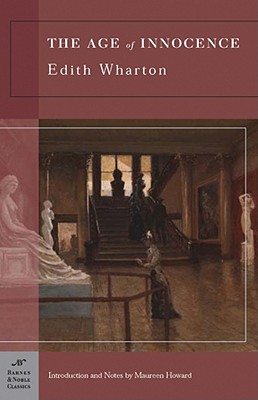 Part I of Age of Innocence sets up Newton Archer as a high-Societyman struggling to identify his place in a stifling, hypocritical and often unfair Society. By Part II, Archer has identified the Society of New York, and recognizes in it its weaknesses and flaws; strengths and promises:
"It was the old New York way, of taking life 'without effusion of blood'; the way of people who dreader scandal more than disease, who placed decency above courage, and who considered that nothing was more ill-bred than 'scenes,' except the behavior of those who gave rise to them." (272)In understanding this, Archer is then faced with a decision: conformity or noncomformity. He must choose between his place (and his duty) and his whimsy (and illicit love).
It is an eminently familiar situation: that battle between what we feel we must do and what we wish we could do; the contest between who we are and who we thought we would grow up to be; the struggle between making ourselves happy with what we have and longing after what we might have had.
"His days were full and they were filled decently. He supposed it was all a man ought to ask.Archer's tale is sad but not without hope; he is disappointed, and somewhat disappointing, but not to an extent that he becomes despicable. He, like so many others, has set out to do what he believes to be the right thing, and upon making his decision, is resigned to living with it. He does not buck (too much) or complain (too often). In that, he is actually rather stoic. Though it is tempting to view him as weak, does it not take some courage to give up a dream in the face of responsibility? And to accept the consequences that accompany it?
Something he knew he had missed: the flower of life. But he thought of it now as a thing so unattainable and improbably that to have repined would have been like despairing because one had not drawn the first prize in a lottery." (281)
Despite some readers' disappointment with the final pages (and at a risk of giving away too much), I believe Archer's actions are instead a perfect reflection of his character: steadfast, courageous, dutiful, aggravating.
Bottom line: Wharton's Age of Innocence is the kind of novel that has sat on the edge of my consciousness for some time without me ever really focusing on it. Now that I finally have, I find it is also the kind of novel that is eminently quotable, easy to relate to, and transcends the both the era in which it was written and the era about which is what written in that perfect way that those books we deem "classics" tend to do.
---
Thoughts from other bookworms:
bookworm meets bookworm
The Story Girl Reviews
Literary Musings
The Novel World
That's What She Read
The Power of Words
21 April 2011
Just a reminder that it's not always what you say, it's how you say it. Words are powerful things.
Subscribe to:
Posts (Atom)


