Showing posts with label young adult. Show all posts

Week in Reading: May 30th

Holy cats, it's the end of May already. When did that happen? How did that happen?

My Memorial Day weekend wasn't quite as reading-and-relaxing focused as I'd have wanted it to be; my mom finished the last of her move on Friday, and I've spent the weekend playing catchup on things in my own house (hellooooo laundry); squeezing in some very hot and humid mileage (including an impromptu 5K this morning that resulted in a new PR!); and generally trying to regain my sense of sanity.


Some of that recovery did include books: I finished Mr. Splitfoot after sleeping in a bit on Saturday morning (what a strange, incredible book) and have had The Nest going on my headphones as I run errands and do chores around the house here (I'm really enjoying it so far--definitely worthy of its summer buzz).

I wrapped up the tail end of Just Mercy last week--just in time to pick up The Long Shadow of Small Ghosts this week for the June edition of the Social Justice Book Club (won't you join us!?). And for some diversity in my reading, I'm also picking away at The Raven Boys, by Maggie Stiefvater, because Shaina and Jenny and others told me to.

And then there are the many summer galleys staring at me, which I currently find too overwhelming to contemplate.

I've got ice in my coffee and sun on my balcony, so that will be all for now. Here's to a week of wonderful reading. And don't forget to sign up for this month's Social Justice Book Club!

---

What are you reading this week?


---


The Social Justice Book Club is an informal group read of a social-justice related book. For June, we're reading The Long Shadow of Small Ghosts, by Laura Tillman. Come join us!

Book Review: Hollow City, by Ransom Riggs

It's finally here: Hollow City, the sequel to Ransom Rigg's creepy, imaginative debut, Miss Peregrine's Home for Peculiar Children. Doesn't it feel like we've waited forever for this book?

Hollow City continues to the story of Jacob and his peculiar friends, picking up right where Miss Peregrine's Home for Peculiar Children left off, so before I continue, let me interject:

Those who haven't read the first in the series will want to go back and start at the beginning, as Riggs doesn't provide a lot of recap in the second volume (a welcome respite from other fantasy series that seem to spend the first 100 pages reminding you of what you've already read). 

Those who haven't read the first in the series may also want to stop reading here, for while I promise not to spoil Hollow City, I can't promise not to spoil Miss Peregrine's.


At the end of Miss Peregrine's Home for Peculiar Children, Jacob and his peculiar friends were left fleeing their small island in Wales, leaving behind the relative safety of their loop to try to save their Miss Peregrine, who happens to be stuck in bird form and cannot transform back into a human, and the fate of the peculiar world in one fell swoop. The gang comes across a menagerie of talking animals; dodges bombs in the London Blitz; and encounters more peculiars in, well, the most peculiar of places.

Though the subject matter can sometime be a bit dark (there's something inherently terrifying about the Blitz, in my mind), the story is imbued with a kind of childish hope that keeps it from ever feeling too heavy. Jacob and Emma's romance evolves, and Jacob himself continues to question how--and if--he fits into this peculiar world. It's an interesting twist on the coming-of-age story, transporting a young teenager into a time and place that is not his own to force him to start questioning where he belongs, and it works.

And, as we've come to expect from the ever-imaginative Riggs, Hollow City combines morbidly fascinating vintage photographs with a healthy dose of monsters, villains and superpowers to continue the story of Miss Peregrine's peculiar children. Hollow City ends on, yes, another cliffhanger, but the second volume in the Miss Peregrine series should leave no one doubting whether or not the wait will be worth it.

---

View the delightfully strange trailers for Hollow City below:


---

Note: Thanks to the publisher for providing a copy of this title for review.
Hollow City | Ransom Riggs | Quirk Books | Hardcover | January 2014| 400 pages

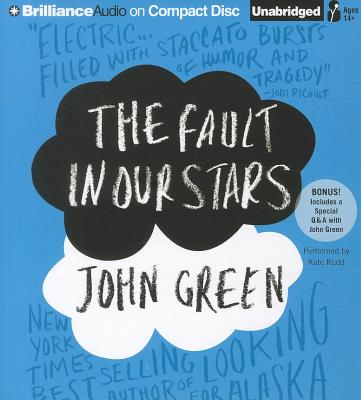
Thoughts: The Fault in Our Stars, by John Green

“Sometimes, you read a book and it fills you with this weird evangelical zeal, and you become convinced that the shattered world will never be put back together unless and until all living humans read the book.”
I'm not going to go so far as to say that The Fault in Our Stars is the kind of book that all living humans need to read, nor will I argue that it is perfect. But I will say it is the kind of book that shatters the world in a way that makes it feel like all of the pieces might not ever go back together perfectly, like everything is slightly askew after you rebuild it.

The Fault in Our Stars is, at its heart, a love story. A girl named Hazel Grace meets a boy named Augustus at a teenage cancer support group. He likes her because she looks like his dead ex-girlfriend, but then because she is kind and smart and funny. She likes him because he is witty* and cute and makes her laugh. They fall in love. They go on adventures. They suffer through the pains of cancer together, her lugging an oxygen tank behind her wherever she goes, he limping around on a prosthetic after losing a leg to cancer. They ruminate on the meaning of life and death and experience. They help their friend Isaac get through the loss of an eye, his adjustment to life without sight, and his devastating break-up with his girlfriend.

In short, except for the cancer, they are just two pretentious teenagers in love. But in their lives, there is no "except for the cancer." It is everything, it shapes everything, it controls everything. And so The Fault in Our Stars quickly becomes more than a teenage love story, morphing into a story of two people trying desperately to hold on to the world and to each other, to control their own destinies, to hold up in the face of pain, and trial, and loss.

On audio, Kate Rudd's narration brings Hazel Grace's character to life more than I think might have happened in print, which makes her hardships only the more difficult to bear. But the narration (both Kate Rudd's voice and Hazel Grace's telling of her story) is not without a touch of hope, for where there is love, there is also happiness. Or something like that. Honestly, I was crying too much at the end to have many deep thoughts beyond how much heartbreak I could stand in one read. And I am not a big book-crier.

The Fault in Our Stars has fallen victim to the hype machine, torn apart by those disappointed in it, elevated beyond reason by those who adore it. But if taken for what it is--a love story between two very sick teenagers--it defies expectations, proving to be bigger than any one descriptor. It will make you re-think what it is to be loved, to love, to be needed, to need, to be in pain, to be dying, to be lost, and to consider that life is just a sum of all the small moments we are given.

---

*My biggest beef with this book was Augustus, because while I know he is meant to be a pretentious teenager, I just cannot believe there are teenagers who talk like that. At all. In fact, I don't even think there are adults who talk like Augustus. He's too smart, too philosophical, too perfectly quippy to be seventeen. But when I was able to gloss over this annoyance, I did sort of love Augustus, after all.

Childish Reading

I was a nervous kid. I was scared of pretty much everything, when I think back on it, especially anything that involved dangerous behavior or breaking the rules. I was actually convinced, at one point, that my parents would go to jail for getting a parking ticket. I clearly didn't understand the gradients of rulebreaking and adventure-making; it was all terrifying to me. 

This fear stretched over into my reading life, where I made all kinds of rules about what I could and could not read. No books with thunderstorms. No books with swords on the cover. And so on.

Which, let me tell you, ruled out a lot of books--especially those my dad really wanted to read to me. He made it all of a paragraph into Treasure Island before I made him stop; that clunking peg-leg spoke of danger and I'd have none of it.

Looking back, I don't remember too much of what I read during that period, though one book stands out: the little-remembered but incredibly beautiful Baby, by Patricia MacLachlan. It was a simple story of a local family living on an island popular with vacationers; when the last ferry of the season left and took with it the screaming children and sunburned noses and folding chairs of summer, a child was left behind with a note asking the family to care for her. Sophia. 

Baby was--still is, I suppose, as it does not appear to be out of print--a story of elegance and beauty, a slow-paced but enthralling tale of family and the power of love and a lot of things that, in hindsight, were way over my eight-year-old head. 

Looking back, I'm convinced that this one book that stands out so vividly among so many others (I had a lot of reading rules but that never stopped me from reading--a lot) formed my adult reading self. Marilynne Robinson's Gilead, and its partner novel, Home, are similar to Baby in their simple beauty and their dealing with the grief and love and happiness of everyday things; they also happen to be among my favorite contemporary novels, heartbreaking and hopeful all wrapped into one. I can't help but think back on Baby as I work my way through The Unlikely Pilgrimage of Harold Fry (which I'm currently adoring).

I eventually learned to break my own reading rules (a habit I try to continue in my current reading adventures), but those early years never quite left me. I don't believe I'm reading childishly, but I do maintain that my childish reading has never truly left me.

Do you find that you are still drawn to the same types of books--if for a different age group--as you were as a kid? Or have you departed completely?

---

Baby | Patricia MacLachlan | Yearling | 1995 | 160 pages | Buy from an independent near you

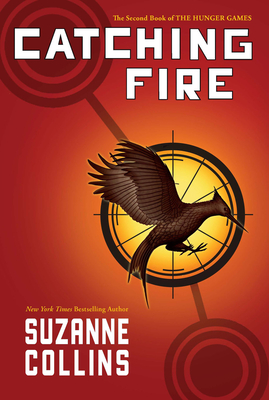
Late to the Party: Catching Fire & Mockingjay, by Suzanne Collins


I'm way late to this party, I know. Not only did I read the books after everyoneelseintheworld, but I have now waited nearly four months between reading the books and writing about them. Oops?

I read both of these on my Nook back in April when flying to and from Italy. They seemed like perfect travel reading to me: easy to get into, easy to get hooked on, and easy to get lost in. What more could you need for 7+ hour flights with crappy in-flight movies as an alternative?

I was right on all accounts. The books are easy to get into (though you definitely have to have read the first to get the second and third), easy to get hooked on, and totally make the time fly. Collins builds further on the world she developed in The Hunger Games, bringing back some favorite characters, introducing some new characters, and giving life to characters previously mentioned only in passing. There's guts, there's gore, and there is, of course, a healthy dose of sappy romance.

Overall, I'd still call The Hunger Games my favorite of the three, but the trilogy works as a whole. I'll never call these great literature, but they are definitely great stories (despite some obvious plot flaws in Mockingjay).

And for those wondering, I'm all about Team Peeta. FTW.

---

Catching Fire | Suzanne Collins | Scholastic Press | September 2009 | Hardcover | 400 pages | Buy from an independent bookstore near you

Mockingjay | Suzanne Collins | Scholastic Press | August 2010 | Hardcover | 400 pages | Buy from an independent bookstore near you

Not Just for the Young, but the Young at Heart


Book Review: The Hunger Games, by Suzanne Collins

Or, the post in which I admit that I read a YA-bestseller that wasn't Harry Potter and actually liked it.

You'd have to have been living under a rock for the last few years to not have heard of The Hunger Games trilogy at this point. It's so ubiquitous that it is even making appearances in the #Occupy movements. At least it did this one time, at any rate. Because it is so everywhere-and-in-your-face-and-read-me-read-me-read-me, I did the only natural thing a book snob like myself could do: I avoided it.

That is, until a good friend and fellow blogger sent me a copy and insisted - yes, insisted - that despite all the things I thought I knew about it, I had to read it. She coupled this argument with the fact that I would be able to finish it in an afternoon. Figuring I had nothing to lose but a few hours and some of my pride at insisting that it wasn't for me, I took a stab.

What I found between the unsuspecting pages of The Hunger Games was a fast-paced, imaginative and creepy in that this-is-all-too-possible kind of way story. I won't go into the details of the plot, because in all likelihood, anyone reading this has already read the whole trilogy anyway, but for those who don't know the premise:

In the country of Panem, which sounds shockingly like a country that used to be known as the United States, The Capitol dominates. And, somewhat inevitably, there is an attempted revolution. And also inevitably, in a world of dictatorships and dominatrixes, The Capitol thinks up a twisted punishment for this revolt, which doubles as a constant reminder of their power and control: The Hunger Games. Each district must send one boy and one girl to compete in the games each year, in which children are pitted against a series of man-made challenges - and each other - in a fight to survive. Last child standing wins. All the others... well, they are dead, and thereby have not won.

See? I told you it was twisted. I can understand some of the parental objections over the book (although I maintain that attempting to ban a book because it gave your child nightmares is just outrageous), for there is some heavy stuff in there: the importance of family, the concept of sacrifice, the making and breaking of allies. And death. There's all that stuff about death.

Ultimately, Collins' imagination is the savior of the book -- her writing is not. Conversations feel stilted and forced, and characters develop unevenly at best. And don't get me started on the sentences that aren't really sentences.

Despite all of the flaws, though, I'll go back for seconds and thirds with the next two books in the trilogy. Collins has succeeded in creating a masterful world, a world of centralized power and dictator-ship like rule that is all too possible to consider, and a world to which I'd like to return. I'm eager to find out what happens of the whirlwind media storm created by the Games featured in this first installment, and I really do want to know what happens to certain characters-who-shall-not-be-named-but-if-you-read-the-book-you-know-what-I'm-talking-about.

So. To sum up. Maybe not the most well-written book I've read, and certainly not my favorite of ever or even the year, but I've got a soft spot for imagined futures (see my recent review Margaret Atwood's The Year of the Flood), and The Hunger Games fit right in there. Thanks to Emily for the recommendation, the insistence, and then going so far as to send me my own copy of the book -- and for proving that sometimes I don't know what's best for my own reading tastes.

---

It seems I'm on a dystopian, re-imagined future kind of kick. What should I look for next?

---

Thoughts from other bookworms (sharing the same I-read-this-and-SURPRISE!-I-actually-kinda-liked-it feelings):
another cookie crumbles
Dead White Guys
Frederation

---

You might also like:
The Handmaid's Tale by Margaret Atwood
The Year of the Flood by Margaret Atwood
The Hunger Games Companion by Lois Gresh

Colin Meloy (of The Decemberists) Writes a Book


Colin Meloy, perhaps most well known as the frontman for the hit indie band The Decemberists, has just released his first novel. The musician has always been a bibliophile* -- just listen to any one of his songs for proof -- and now he has taken that love to a new level. Wildwood, the first in a planned trilogy, is a 600-page YA novel, with illustrations provided by Meloy's wife, Carson Ellis.

Clearly, I have to read this book. I love The Decemberists. I love artists trying out new things, new mediums, new adventures. I love fantasy novels. And the blurb has me thinking - or perhaps hoping? - that this could be the kind of YA novel that adults fall in love with, too. "Original and fresh yet steeped in classic fantasy"? Sign me up. "Warring creatures" and "peacable mystics"? Must. Read.

See for yourself:


Prue McKeel’s life is ordinary. At least until her baby brother is abducted by a murder of crows. And then things get really weird.

You see, on every map of Portland, Oregon, there is a big splotch of green on the edge of the city labeled “I.W.” This stands for “Impassable Wilderness.” No one’s ever gone in—or at least returned to tell of it.

And this is where the crows take her brother.

So begins an adventure that will take Prue and her friend Curtis deep into the Impassable Wilderness. There they uncover a secret world in the midst of violent upheaval, a world full of warring creatures, peaceable mystics, and powerful figures with the darkest intentions. And what begins as a rescue mission becomes something much bigger as the two friends find themselves entwined in a struggle for the very freedom of this wilderness.

A wilderness the locals call Wildwood.

Wildwood is a spellbinding tale full of wonder, danger, and magic that juxtaposes the thrill of a secret world and modern city life. Original and fresh yet steeped in classic fantasy, this is a novel that could have only come from the imagination of Colin Meloy, celebrated for his inventive and fantastic storytelling as the lead singer of the Decemberists. With dozens of intricate and beautiful illustrations by award-winning artist Carson Ellis, Wildwood is truly a new classic for the twenty-first century.

What do you think? Will you read it? Any other lovers of The Decemberists out there?

*For more about Meloy's love of literature, and how it has influenced his music, and how this book is clearly really awesome, check out Paste Magazine's review of Wildwood, which is the kind of well done contextual review I wish I wrote more of in my life.


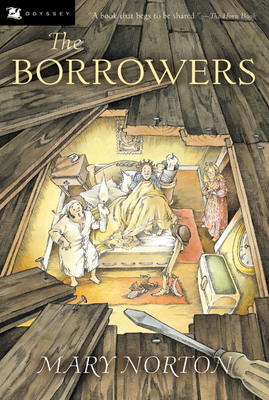
The Borrowers Arrive on BBC

Does anyone else remember The Borrowers, that darling book in which little people live in the walls of a house and borrow items from the owners? I'd say it offers a perfectly plausible explanation for all those items that seem to disappear from my house for no apparent reason: an earring back, one sock, the tweezers, that rubber band band you know you left on your desk. Seriously, borrowers. Where is my rubber band ball?

I loved this book when I was a kid, and I vaguely remember loving the 1997 movie version featuring John Goodman. And now BBC is bringing the stories to the little screen with a 90-minute adaptation of The Borrowers set to air this Christmas season. Who's excited!?

Book Love for Your Fridge (or Other Magnetic Surface)


Bottlecap booklover magnets from PendantLicious, $6.95 on Etsy

Libba Bray... A Mad Cow.

Book trailers seem to be the new hit thing for book promotions, and while I don't dislike them (I even went so far as to put the Sense and Sensibility and Sea Monsters preview in a blog post), I must admit, I also don't quite get them. I recently stumbled into a link to Libba Bray's book trailer for Going Bovine, however, reviewed here, and she seems to have struck on something more than the traditional dramatization/read-the-back-cover-blurb book trailer. Seriously. Libba Bray. Dressed as a cow. Wandering Random House offices and the streets of New York. You don't want to miss it.

The video isn't available anywhere that I can seem to embed it, but it is on Entertainment Weekly's Shelf Talker here.

A New Trend in My Reading - Books That Ask The Big Questions


I recently finished two very different and yet strikingly similar books - Ian McEwan's Atonement, which I was hesitant to open despite all of the praise and suggestions heaped on it, and Libba Bray's Going Bovine, a galley of which I picked up at Random House's booth at BEA. While one is the story of the repercussions of one seemingly small act and the world of World War II Britain, and the other the tale of a struggling teenager with hallucinations and a deadly disease, both address the fundamental question of life and reading: What is real, and what is not, and what does it matter?

Atonement:

Most of you probably know the basic story of Atonement, whether it be from the book or the movie. I'm pretty much the last person in the world to read this one, I think, but I must say, it's not at all what I expected. In Atonement, McEwan turns his graceful prose to one event in one family's history, retelling it carefully from each perspective involved. There are events, there is a lie, there is a coverup, a trial, jail time, a war, a wedding, an apology, an atonement - or is there? That there is a crucial event we are sure of. That there is a lie that follows it we are also sure of. That a soldier goes to war and experiences the horrors of Dunkirk we are also sure of. But then the writer of this novel reveals herself - for it is not written by McEwan at all - and we go back and question everything we have read, for it is nearly impossible to tell where the story begins and the facts end.

McEwan's ability to drive a story forward while simply retelling the same plot points over and over again is uncanny; his ability to set forth the most beautiful descriptions of an English country home and the intricacies of a battlefield is shocking; his ability to make us question everything he has put to the paper is outstanding. This is a sweeping work that goes beyond the interactions of human experience to ask: What is the impact of our perception on reality, and which matters more?

Going Bovine
Libba Bray's book is a young-adult title focusing on a teenager adjusting to life in a modern-day Texan high school - and adjusting poorly, to say the least. He is withdrawn, a stoner, a loner, and altogether makes himself miserable. This is only further compounded by the fact that he is diagnosed with a fatal illness, and is only noticed by his peers when it is announced that he has only weeks to live. From here, though, things get weird: a punk angel/possible hallucination shows up in the hospital room and gives him not-so-detailed instructions on the way to simultaneously save the world and find a cure for his disease. With his trusty sidekick, hypochondriac and little person Gonzo, he flees the hospital and travels across the country to New Orleans, the YA! (equivalent of MTV) Spring Break house party, and through time itself. He enlists the help of a cult a one point, is guardian angel at others, a mad scientist here, a jazz musician, and even a talking garden gnome. Or does he? Or rather, does it matter if he does or does not, as long as he thinks he does? What is life, after all, but a series of remembered experiences?

Bray's novel will touch anyone who ever went to high school in a way we'd like to pretend it can't, groping with the difficult questions of popularity, sexuality, drugs, family life and, the be-all end-all of a teen's existence, mere acceptance. Her story will literally have you laughing out loud and then bring tears to your eyes in a matter of pages, but along the way, it will never fail to impress upon its readers that life is what we make of it.

It was book destiny that this galley landed in my collection at BEA, and it couldn't have landed at a better time. I cannot emphasize enough how much I enjoyed it. An absolute must-read.