Showing posts with label e-books. Show all posts
Clean Your Reader: A Wrap-Up (and For Me, Lessons Learned)
10 April 2016
But first, an apology: I've been a terrible host of the CleanYourReader challenge. So much so that many of you probably don't even know it's been an ongoing thing that some readers (myself very much not included) have been participating in with all the diligence I'd hoped to inspire in myself.
The goal for Clean Your Reader was simple: Over a three-month time period (January to March), make an effort to finally, finally read all the e-books collecting dust on our e-readers. Some participants did a great job. I, on the other hand, read one e-book. One!
The 2016 Clean Your Reader Challenge: Join Us!
01 December 2015
Come one, come all, to the 2016 Clean Your Reader Challenge.
The goal is simple: read as many (or as few) e-books from your e-reader as you like over a three-month period (January through March 2016). Because I'm not great at hosting (or participating in) challenges with lots of rules and regulations, that's all there is for structure, but here are a few guidelines and suggestions:
Clean Your Reader: A Challenge!
31 December 2014
'Tis the season of mulled spiced things, long books... and e-book deals. And deals. And deals. And if you're anything like me, you're a sucker for those e-book deals. Even though, let's be honest, we all have dozens of unread e-books on our e-readers already. So I'm putting out the Clean Your Reader Challenge, because my (admittedly half-assed) Google searching for a comparable short-term reading challenge yielded nothing, and I do better at these kinds of things when I can convince/bribe other people to join me in my follies.
The goal is simple: Spend January reading some of those e-books you bought because you just had to read them someday and they were only $1.99! We can do this, right?
I'm not good at managing multiple levels and all that jazz, so to sign up, link to your sign-up post using the Linky below.
I'll be posting here about my progress, and updating on Twitter and Instagram with the hashtag #cleanyourreader.
The goal is simple: Spend January reading some of those e-books you bought because you just had to read them someday and they were only $1.99! We can do this, right?
I'm not good at managing multiple levels and all that jazz, so to sign up, link to your sign-up post using the Linky below.
Sign-Up Post
What's your e-reader of choice?
What e-books or e-book deals are you incapable of saying no to?
How many e-books are you going to try to tackle in January?
(Feel free to grab the image above to use in your post, if you want!)
I'll be posting here about my progress, and updating on Twitter and Instagram with the hashtag #cleanyourreader.
Along the Way
It would be awesome to hear what you think of those e-books you've been collecting along the way, but you don't need to post reviews of each title to participate (or be eligible for contest prizes... see below). Simply post at the beginning about your goals, and the end with your outcomes. Anything beyond that is invited but not required!
Prizes!
Everyone who completes the challenge (that is, links up at the end of January on how it went) will be entered to win an e-reader cover, valued up to $40, for the e-reader of their choice. Due to shipping costs, this prize is limited to US residents--but if you are international and win, I'll gift a comparably valued gift certificate so you can purchase one yourself. If you're not international but prefer an e-book gift certificate to your e-book vendor of choice instead of a new cover, that's fine too!
Questions?
Let me know.
Clean Your Reader: Sign-Up Post
16 December 2014
My e-reader of choice...
... is a Nook. Specifically, I have the e-ink Nook and the Nook HD+. I take the little one to the beach and when I travel for long periods of time, because it stands up to the sun and holds a battery charge for long periods of time. I take the big one when I travel for shorter periods, often in place of my laptop, because it multi-tasks as a tablet. I use the Oyster app on the HD+, but I get most of my e-books through Barnes & Noble these days.
I can't say no to...
... e-books at the $1.99 price point. I buy plenty of full-priced e-books, but those are rarely impulse buys--they are books I want to read for a specific reason at a specific time, so I find them, buy them, read them. The ones that accumulate are the ones that I see and think, "Oh! I've been wanting to read that! And look--it's only $1.99! I'll buy it now so I have it and read it later when I feel like it." At which point I promptly forget about it.
My goal for Clean Your Reader...
... is to read 5 of the e-books on my reader in January. I have the benefit of being slightly ahead of schedule on my review copies, and the fact that several of the books on my e-reader are short, so I'm hopeful I can do more... but at the very least, plan to do 5.
Are you joining in to Clean Your Reader, too? Sign up here!
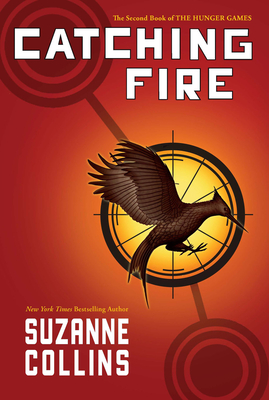
Late to the Party: Catching Fire & Mockingjay, by Suzanne Collins
22 September 2012
I'm way late to this party, I know. Not only did I read the books after everyoneelseintheworld, but I have now waited nearly four months between reading the books and writing about them. Oops?
I read both of these on my Nook back in April when flying to and from Italy. They seemed like perfect travel reading to me: easy to get into, easy to get hooked on, and easy to get lost in. What more could you need for 7+ hour flights with crappy in-flight movies as an alternative?
I was right on all accounts. The books are easy to get into (though you definitely have to have read the first to get the second and third), easy to get hooked on, and totally make the time fly. Collins builds further on the world she developed in The Hunger Games, bringing back some favorite characters, introducing some new characters, and giving life to characters previously mentioned only in passing. There's guts, there's gore, and there is, of course, a healthy dose of sappy romance.
Overall, I'd still call The Hunger Games my favorite of the three, but the trilogy works as a whole. I'll never call these great literature, but they are definitely great stories (despite some obvious plot flaws in Mockingjay).
And for those wondering, I'm all about Team Peeta. FTW.
---
Catching Fire | Suzanne Collins | Scholastic Press | September 2009 | Hardcover | 400 pages | Buy from an independent bookstore near you
Mockingjay | Suzanne Collins | Scholastic Press | August 2010 | Hardcover | 400 pages | Buy from an independent bookstore near you
National Book Festival
25 September 2011
We've all seen the headlines lately -- Borders closing, publisher lay-offs, downsizing, cutting costs, etc. Couple the bad news with the fear of the e-book trend, and it's really no wonder that the cries of "The book is dead! The book is dying!" continue to sound. But then I spent a day at the National Book Festival, wandering around the masses and masses of people that had come to hear authors speak, get books signed, and generally partake in an orgy of book love. Despite the rain, and the oh-my-god-it's-like-walking-through-pudding-humidity, and the broken escalators on the Metro, thousands upon thousands of people attended the free-to-all show.
There are those that will argue that any free entertainment will draw crowds, and I agree. But the fact that, free or no, people of all ages flocked to the Mall to celebrate the book tells me that there is still an indelible love for books in all of us. Children were excited to make their own bookmarks and hear authors in the storytelling tent, and adults in crowds ten-deep behind the seated areas of author-speaking tents. I sat for 45 minutes stalking open seats to score three together for Sarah Vowell's talk (I love her).
To me, it doesn't matter how we read, or really even what we read, so long as we continue to read. The National Book Festival was an event seemingly born of this ideal, celebrating the book, its authors, the institutions that support it, and the people who consume it. Well done, Library of Congress.
E-Reader Courtesies
14 June 2011
So I'm sitting on an airplane yesterday, flying to Chicago (hello, Chicago!), and the man sitting next to me (and too close to me, if you want my opinion) pulls out an iPad and opens his Kindle reader. The angle at which he holds the device allows me to see that he is reading Matterhorn, a book I've had my eye on for some time.
Now, if this were a print book, I would not have hesitated to make a bit of small talk and ask about the book. But if this had been a print book, I would have recognized the book by its cover, not by looking over the man's shoulder (I guess I'm nosy like that). And I would have been able to see how far into the book he was - if only five pages, I wouldn't ask how it he liked the book, you know?
In the spirit of not being that obnoxious person that talks too much on an airplane and snoops into others' business, I let the matter go. But it left me thinking: what is acceptable in this (or similar) situations? Is it ok to admit that I can see your iPad screen perfectly clearly and am interested in what you are reading? Is it rude to peek in the first place?
Read Forever
10 May 2011
Barnes & Noble launched their new Read Forever ad campaign at the end of April, with TV spots and print ads emphasizing the notion of reading forever. According to a New York Times article on the campaign, the ads feature a hopeful message: "Reading is changing, but it’s not going away."
The article also posits that the lack of images of any Barnes & Noble stores in the ads is an accurate reflection of the current transition in the publishing marketplace: brick-and-mortar foot traffic is down, online purchases are up.
And Barnes & Noble wants the Nook (specifically, the Nook Color) to take a cut of those online purchases. Hence, the campaign. Duh.
To this marketer's mind, Barnes & Noble had two main challenges to overcome in the marketplace. First, the resistance to e-books and e-readers that has been displayed by many tried-and-true bookworms (like yours truly). Second, the simple fact that the Kindle beat them to it, and "Kindle" has, to many, become synonymous with "e-reader," just as we've abandoned "self-adhesive bandage" (too many words) in favor of "Band-Aid" (the first of its kind, you kn0w).
And to this bookworm's mind, the campaign hits it out of the park on both accounts. It hits the emotional nail on its proverbial head. By focusing on books instead of readers, the ads succeed in not driving e-book hesistants away at first glance; by scattering the Nook among images of people reading real, old-fashioned p-books, the ads successfully (I think) position the Nook as just one among many ways to read.
In short, it celebrates the act of reading rather than the way in which we choose to do it. What better way to celebrate a new way to read the books we already cherish?
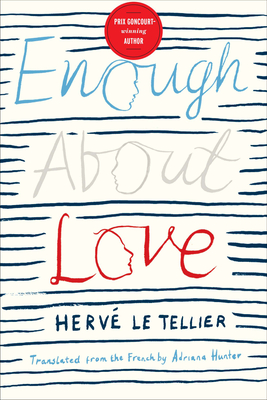
Book Review: Enough About Love by Hervé le Tellier
05 April 2011
Le Tellier's writing is strong and well-crafted; he weaves a complicated web of storylines without ever losing track of where he is or where he is going. His writing is neat and orderly and philosophical; his characters are messy and deep and confused. He is eminently quotable, with passages speaking to the nature of love, reading, romance, sex, friendship; his story is heartfelt and meaningful, flawed in the way that real life is flawed. He is an author tackling big life issues in small life events; his work is very, very French.
Enough About Love is intriguing from the first you read the title - which, to be frank, is the main reason I was drawn into this book - to the moment you turn the last page and realize with a startling frankness that really, there never is "enough about love." It's a subject we will continue to muse over, meddle with, write about, etc. It will at once give us a place in which we belong and yet continue to break our hearts. It will keep poets writing poetry, singers singing songs, author crafting novels. And precisely because he understands this, le Tellier's Enough About Love is intriguingly relevant, no matter what language you read it in.
---
Thoughts from other bookworms:
Literary License: Short Reviews with Real Opinions
My Books. My Life.
The Book Lady's Blog
The Boston Bibliophile
---
Many thanks to Other Press for providing an e-galley of this title for review, via NetGalley.
Newsweek Questions the Future of Reading: "Big Brains on e-Books"
07 February 2011
The last few weeks have been good to bookworms, with one rich and though-provoking article following the last. Last week I featured HuffPost's discussion of how to keep book reviews relevant. Today, Shelf Awareness excerpted a quote from Newsweek's article on the future of reading, Big Brains on e-Books.
The article kicks of with the oft-repeated and still-unintelligible-to-me claim that Amazon's e-books now outsell paperbacks before polling some well-known bookworms on their thoughts on e-books and e-readers and the future of reading:
Personally, I avoid reading editorial introductions to any book I have not yet read. I tend to skim the back-cover summary to see what a book is about, but avoid learning much more about it so I can form my own opinion. The book is a standalone item, and if it fails to succeed without the noise that surrounds it... well, then it's failed to succeed.
So. I have an e-reader, though I have yet to complete an entire book on it. I am intrigued by the convenience of an e-reader, and the options for enhanced e-books. There are some titles - like War in the Pacific - which cry out for an enhanced e-book, but I believe this is an area in which authors, publishers and editors should tread lightly. It's just one quick slip to fall into the imagined world of Ron Charles, after all. What about you? Thoughts? Do you have an e-reader? Do you read enhanced e-books?
The article kicks of with the oft-repeated and still-unintelligible-to-me claim that Amazon's e-books now outsell paperbacks before polling some well-known bookworms on their thoughts on e-books and e-readers and the future of reading:
"Not to diminish the value of a paperback, when it comes to somebody investing in a hardcover, it’s something you want to keep. Everything from a cloth-case wrap to a leatherette to a foil-stamped cover, heavier paper, better binding, innovative cover design. You have to give readers a choice, between a richer experience with paper and board and cloth, and a more sterile experience through an electronic reader. We just try to make every aspect of the physical book as good as it can possibly be, because that’s our greatest hedge against the dominance of e-books." -Dave EggersI've written before about the power of a paper book (whether paperback or hardcover) over an e-book, particularly in the arena of smell. Eggers, like so many other bookworms, is acutely aware of the power of a physical book to captivate and spellbind readers, and despite the convenience of e-books, we have yet to see them figure out that part of the industry.
"How you read is not as important as: will you read? And will you read something that’s a book—the sustained train of thought of one person speaking to another? Search techniques are embedded in e-books that invite people to dabble rather than follow a full train of thought. This is part of a general cultural problem." - James H. Billington, Librarian of Congress (this passage also quoted in today's Shelf Awareness)This is why Billington is the Librarian of Congress and I am not: he's managed to put into words my own problem with e-books and the concept of enhanced e-books (which Ron Charles also touched on in one of his Totally Hip Book Reviews). E-books, and particularly enhanced e-books, are designed to give readers more options, more content, more information. But when reading a book, do we really need all that? Do we even want it? The book itself should shine through on its own, without the aid of author interviews, blurbs from famous people, or embedded video.
Personally, I avoid reading editorial introductions to any book I have not yet read. I tend to skim the back-cover summary to see what a book is about, but avoid learning much more about it so I can form my own opinion. The book is a standalone item, and if it fails to succeed without the noise that surrounds it... well, then it's failed to succeed.
So. I have an e-reader, though I have yet to complete an entire book on it. I am intrigued by the convenience of an e-reader, and the options for enhanced e-books. There are some titles - like War in the Pacific - which cry out for an enhanced e-book, but I believe this is an area in which authors, publishers and editors should tread lightly. It's just one quick slip to fall into the imagined world of Ron Charles, after all. What about you? Thoughts? Do you have an e-reader? Do you read enhanced e-books?
Hug a Book (Quote of the Day)
09 January 2011
"You can't hug an iPad." -Nancy Pearl, when asked at a book signing at Wide World of Books & Maps if she used an e-reader.
Via Shelf Awareness, Monday, Dec 20th.
The Saga of the Sony Pocket Reader
23 November 2010
Dear readers, I have neglected to inform you of a very important development in my reading life - the acquisition of a Sony Pocket Reader. Those of you who follow me on Twitter might have seen my initial disappointments with the thing (the screen broke after only a few weeks of use), but my blog-only followers most likely know nothing of this saga. [Note: Sony replaced the Reader and even let me keep the extra charger. No hard feelings, although the process wasn't quite painless.]
I've let the issue lie for several months so I could give the thing accurate feedback. So far, I must admit, I am less than impressed. The device itself functions well (although I wish it was Wifi-compatible), and the screen is easy to read, etc, etc. In fact, much to my surprise, I have no actual complaints with the device or the technology itself.
Instead, though, I find I have criticisms of my own reading habits when reading digitally. Case in point: I have yet to actually complete a book on the Reader. I've started several - some for work, some e-galleys from NetGalley, a few downloads from Gutenberg (notice I have yet to actually purchase a book, which is enough matter for a separate post) - but have not yet read a "The End" page in e-ink. I've enjoyed those books I started - including Our Tragic Universe, which I had been itching to read for some time, and the first half of Road to Bedlam, which I ultimately completed in paperback and reviewed a few weeks after starting it on the Sony Reader.
No, when I read on the e-ink screen, I for one feel a distinct lack of connection with the words in front of me. Maybe I'm biased - I'm certainly pre-disposed to love the look, feel and smell of printed book - or maybe it's just my own personal reading style, but screen-reading has yet to catch on for me. I gave it a six-month shot, and remain unimpressed.
Am I just using the wrong device? Am I reading the wrong books? Am I going about this in entirely the wrong way? Does anyone else feel this disconnect? For those that do enjoy their e-readers, any advice? It would carve a significant amount of added space into my house if I could start collecting digital files instead of dusty old hardbacks and ARCs I have yet to read...
Sharing is Caring - An Amazon Tale
26 October 2010
Last week, Amazon finally learned that crucial lesson that the rest of the world learned in kindergarten: sharing is good for us. For the first time in Kindle's short history, Kindle users will finally be allowed to share their purchases with friends. The lending options will be available "later this year," according to Amazon's announcement.
The sharing comes with a few catches, of course - books can only be lent for a period of 14 days (which, if you're as bad at planning reading choices as I am, could prove problematic), and the owner cannot access the book while it is lent out. Of course, the counterargument to those who protest this last restriction is simple: you can't access a paper book that you've lent to your friend, either, unless you kept photocopies of it on your shelf in the meantime?
Amazon will let publishers (or rights-holders, as the case may be) choose whether or not to participate in the sharing program.
It appears that the details of the lending program are still fuzzy. Case in point: will lending be available to any Kindle App users, across platforms, or just other Kindle users? I'm also unclear on whether or not sharing options will be made clear to buyers before purchasing - has anyone heard more about this?
Read the original announcement or the TechCrunch article for more information.
Macmillan's John Sargent Creates a Blog
08 March 2010
For those of you following the Amazon-Macmillan price wars, or the least bit interested in e-books and e-book pricing, I highly recommend that you check out the new blog created by Macmillan CEO John Sargent. He presents his blogging efforts thusly:
After the events of the past several weeks, I have been in touch with many of you. It has become clear to me that there is far too little accurate information available in this time of unprecedented change. The issues we all face together are complex, and no news story or 140-character snippet can adequately address them. Therefore, I propose to write you occasionally, when I get a sense that there is a need for direct information.Enjoy!!
NY Times Revisits E-Book Pricing
02 March 2010
I know, I know, I go on and on about e-book pricing. But for the publishing industry (which in this case I use to incorporate the broader world of authors, writers, marketers, bookstores, etc), e-books are poised in a precarious position: they can make the industry, attracting new readers via new reading platforms, or break the industry, turning consumers away from print books in favor of the easier-to-access and cheaper e-books.
The NY Times posted a really useful article on Sunday regarding the pricing of e-books, complete with an analysis of a publisher's costs for the production, sale, distribution, and marketing of each book (not to mention overhead costs like salaries of people like me!). They extended this analysis into both print books and e-books, and actually, the profit margins are slightly surprising...
But I ramble. I can't summarize the article as well as you could just read it yourselves: NYTimes - Math of Publishing Meets the E-Book
Hope for All of Us Who Love to Hate Typos and Bad Grammar
12 February 2010
Yes, there is hope for all of us who hate - and love to hate - typos and bad grammar and general bad editing! As reported by Teleread this week, Rich Adin has created a book Hall of Shame. The concept is quite simple: books will be added to the Hall of Shame not based on the quality of the story, but the quality of the writing and editing. Is the book full of typos? Poorly formatted? Full of inconsistencies? This is where readers can voice their opinions.
Branding the iPad
08 February 2010
Perhaps the most rampant criticisms of the iPad (besides the lack of camera, lack of Flash, lack of e-ink, lack of multi-tasking... did I miss anything?) center around the name. Many reports have claimed women are offended by the name because of its connotation with "sanitary napkins" (a term I've always despised). Personally, I think that's taking the gender barrier a bit too far... but there are a host of funny alternatives floating around out there: iTampon (a thumb-size drive for your iPad) and MaxiPad (either the pink alternative or the larger-disk-space alternative).
The most interesting bit of the debate (in my mind, anyway) is the role MadTV has come to play - after all, they released a skit of two women joking about a device called the "iPad" years before the rumors on an Apple tablet became mainstream.
E-books Won't Kill P-books
05 February 2010
Earlier this week, YA author Katherine Paterson (Bridge to Terabithia) wrote an op-ed piece entitled "Apple's iPad is no book-killer" for the New York Daily News. It's short, but to the point. And with cleverly incorporated references to Plato and Socrates' fear of literacy as the death of poetry, Paterson lays bare our fears of the loss of the book.
True, the development of a literate society has forever changed how we listen and how we consume literature, but it has not killed an interest in either. And, if the book truly is "the perfect technology," as Paterson writes, it will withstand the test of time.
Anyway, check out the article - it's well worth a read. Happy Friday!
Tor Authors Speak on Amazon/Macmillan Debate, and Booksellers Support Macmillan
04 February 2010
Simon Owen, over at Bloggasm (no, not the same thing as Bookgasm), recently sent me a link to his blog post on the Amazon/Macmillan debate. He had a chance to speak with a few Tor authors (a science-fiction and fantasy publisher that is part of Macmillan), and the article was pretty interesting. Great to get a different perspective on the ongoing discussions as well.
In relation to Tor authors, and other science-fiction and fantasy authors published by Macmillan, the Science Fiction Writers of America (SWFA) are removing any links to Amazon from their site, instead sending customers to Indiebound, Borders, Barnes & Noble, and Powell's. You can read the SWFA release, with their reasoning behind this decision, here.
One Week After the Storm...
One week after Apple announced the iPad, and have you seen the debates? There are those who love it, those who hate it, those to love to hate it and hate to love it... you get my drift. Is there an overall consensus? It's hard to say. But here's what a few top-notches are saying these days:
Subscribe to:
Posts (Atom)