Showing posts with label 2014 books. Show all posts

Bloggiesta!


Bloggiesta is this week, and what better time to do some much-needed maintenance around these parts? I've never participated before, despite always wanting to do so. I'll be updating this post along the way with progress, and then will post a culmination at the end of the week.

Book Review: Alphabet, by Kathy Page

This review originally ran in Shelf Awareness for Readers. Reprinted here with permission.

In Alphabet, Kathy Page (Paradise and Elsewhere) explores the inner workings of Simon Austen, a complicated, confused and confusing criminal sentenced to life in prison for murdering his girlfriend. Tattooed across Austen's body are words he has been called in his lifetime of mistakes: "threat to women," "dumb," "waste of space." They mark him as a criminal and a killer--but they also give some insight into how Simon came to be the man he is today, shaped as much by his mother's abandonment and his experience in foster care when he was a young child as by the crime he committed and by the British penal system of the late 1980s.

Alphabet tracks Austen's time in prison over several years, from the high-security facility where he struggles to show remorse to the rehabilitation clinic where various therapies aim to "cure" him of his dangerous sexual leanings and help him reinvent himself. Page weaves together Austen's complex inner dialogues and accounts of his experiences in prison, revealing him as a multifaceted human being: not a cold-blooded killer, but rather a sympathetic character, struggling to understand that love and friendship are ultimately what free us, not what jail us. Along the way, Alphabet transforms from a novel of crime and punishment into a nuanced psychological profile of a killer, ultimately providing a gut-wrenching reminder of the atrocities contained within institutional walls and the lengths to which we are willing to go in order to protect our innermost selves.

---


A copy of this title was provided by the publisher for review.
Alphabet | Kathy Page | Biblioasis | Trade Paper | October 2014 | Buy from an independent bookseller near you

Nonfiction November: Focus on Poverty in the United States

We've all heard it, or some variation of it: "I don't give homeless people money because they should just get a job." What statements like this fail to acknowledge, however, is eternally complex question of the root causes of poverty; it is, unfortunately, no guarantee that a job will prevent you from being homeless, any more than it is a guarantee that being homeless means you have no job.

Though we have stopped the Dickensian tradition of jailing debtors, the stigma that accompanies poverty doesn't appear to be going anywhere anytime fast. But there are authors out there who are doing their damnedest to at least shed a light on some of the actualities of life in poverty, peeking beyond the myths and the stories and the stereotypes to see the people of poverty, the system of poverty, and the cycle of poverty:

poverty in america

The Short and Tragic Life of Robert Peace, by Jeffrey Hobbs: Hobbs wrote this biography of his college roommate, Robert Peace, after Peace was murdered in the basement of a house in Newark, New Jersey, where he was working as a drug dealer after graduating from Yale with honors. Hobbs exploration of his friend's life is at once an attempt to understand how this young man, so seemingly poised for success despite overwhelming odds, ended up back where he started, as well as a study of the power of poverty in the United States today. Seriously, incredibly eye-opening. Full review.

Nickel and Dimed, by Barbara Ehrenreich: Ehrenreich went "undercover" in 1998 to see what life was really like for those American workers putting in full-time hours (often more-than) in the "unskilled" jobs of our country. She worked at Walmart, she cleaned hotel rooms, she waited tables. She made readers reconsider how their everyday amenities--big box stores, hotel stays, the food on their tables--came to be, and nearly 20 years later, the book is just as important as it was in 1998. Which is saying something about how far--or not--the world of American poverty has come in the last 16 years, isn't it?

The Working Poor, by David K. Shipler: Shipler's book is similar to Ehrenreich's in that it explores not the most destitute, but those hovering just around the poverty line while working as hard as possible to make ends meet. I'm halfway through this one, and while some of the facts seem like they should be obvious, Shipler's support of assumptions with numbers and data and anecdotal evidence really brings things home.

Fire in the Ashes, by Jonathan Kozol: Subtitled "Twenty-Five Years Among the Poorest Children in America", Kozol's newest book returns to the children he wrote about in Rachel and Her Children and Amazing Grace to share their "journeys and unexpected victories as they grow into adulthood."

Hand to Mouth: Living in Boostrap America, by Linda Tirado: I'm not even going to try to summarize this one, I'm just going to give you the jacket copy: "We in America have certain fixed ideas of what it means to be poor. Poor people live in shelters. They are on welfare. They go to soup kitchens. To some, poor people are lazy. And even the most enlightened of liberals have wondered aloud, 'Why do poor people make such bad choices?' Linda Tirado, in her signature frank yet personable voice, takes these preconceived notions of what it's like to be poor and smashes them to bits."

Rosa Lee: A Mother and Her Family in Urban America, by Leon Dash: The story of Rosa Lee, a woman falling deeper and deeper into poverty in Washington, D.C. The book is based on a series of Washington Post articles that ran beginning in September of 1994, and though the title is less well-known today than others (Nickel and Dimed) of the same decade, I'm very much intrigued.

---

Interestingly, most of the books about poverty that have come across my radar are a) written by white people (even though poverty disproportionately impacts non-white people in the United States (in 2012, the overall poverty rate in the US was 15%; for Whites, 9.7%; for Blacks, 27.2%; for Asians, 11.7%; for Hispanics (of any race), 25.6%))*, and b) are written from an outsider's perspective (even when said outsider is embedded deep within a group, as in Ehrenreich's case).

If anyone has suggestions for books that address the potential one-sidedness of this list, I'd love to hear them! In the meantime, rest assured that I'll be a-Googling this.

* Source: www.povertyusa.org

---


This post is part of Nonfiction November's week 2 theme: Be/Become/Ask the Expert on a subject. 

Book Review: How Star Wars Conquered the Universe, by Chris Taylor

This review originally ran in Shelf Awareness for Readers. Reprinted here with permission.


The Star Wars franchise is no small thing, with an estimated 1.3 billion tickets sold to the six theatrically released movies worldwide, $6 billion in VHS/DVD sales and $20 billion in merchandise sales. But how did it grow from the impossible dream of a young filmmaker to a multibillion-dollar franchise? Journalist Chris Taylor answers that question in How Star Wars Conquered the Universe, which covers not only the "past, present and future" of what might be the world's most ubiquitous franchise, but also how it has made an impact on--and been influenced by--its ever-growing fan base.

Taylor weaves George Lucas's biography with a history of science fiction and space fantasy in print and on screen, which he then fits into an exploration of Lucas's creative approach to each of the six films and the timely political undertones in each story. He then turns to the Expanded Universe (the body of Star Wars books, games, TV shows and other sanctioned stories) and how it interacts with Lucas's big-screen creations.

Taylor doesn's shy away from criticisms of Lucasfilm or the movies themselves, such as flaws in the plotlines or tensions on the film sets. But at its heart, How Star Wars Conquered the Universe is a love letter to a franchise that has become entrenched in contemporary culture in more ways than we could possibly count (just think how difficult it would be to find someone, anyone, who does not know the identity of Luke's father), and a testament to the power of space fantasy to capture our imaginations.

---


A copy of this title was provided by the publisher for review.
How Star Wars Conquered the Universe | Chris Taylor | Basic Books | Hardcover | October 2014


Looking Ahead: November Books

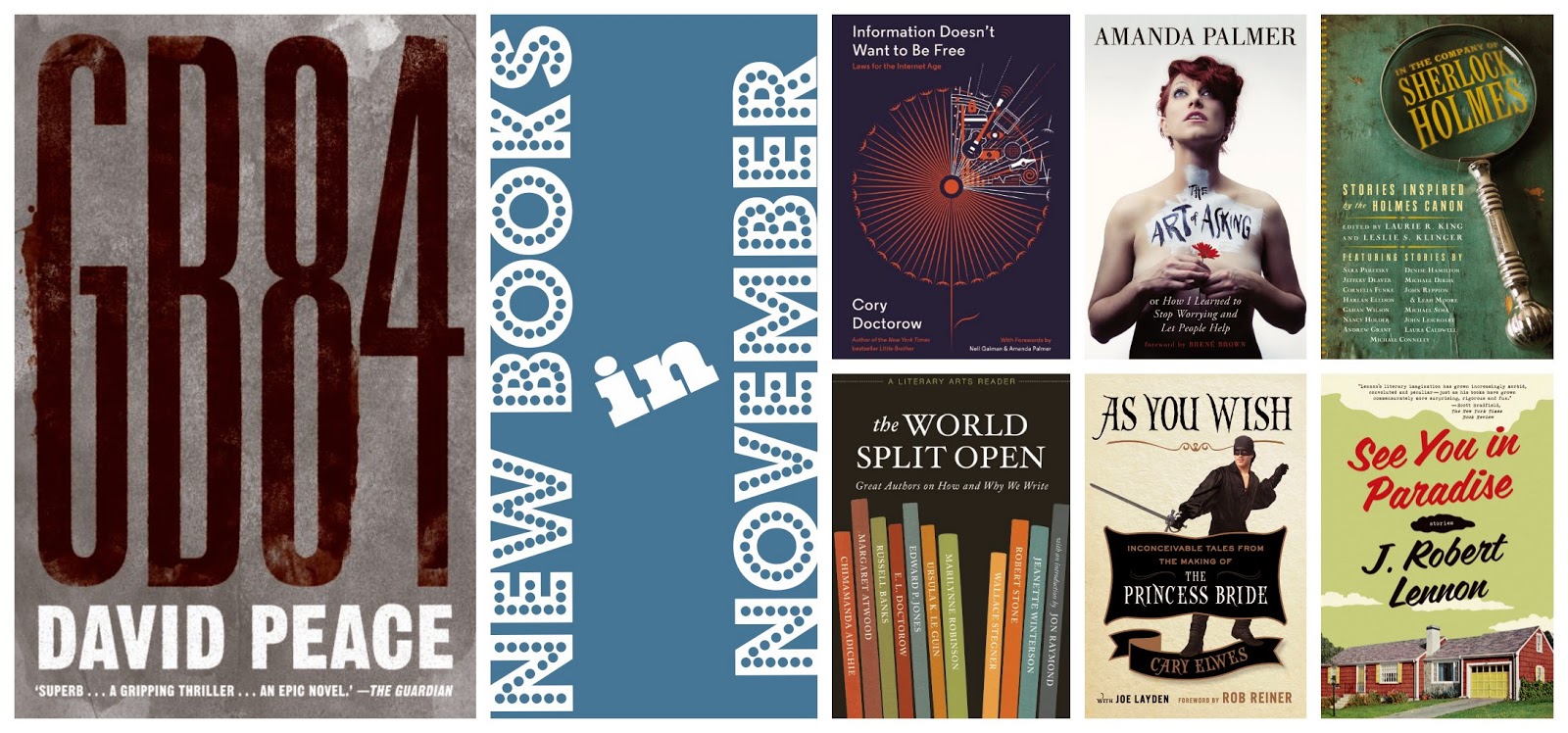
October set the bar pretty damn high for November reads, but I have confidence that this list contains some (ok, I've read a lot of them already, so I can safely say many) gems. These books will make perfect companions for longer nights and the chillier weather that is settling in on the mid-Atlantic.*


As You Wish, by Cary Elwes: Ok, I cheated here, because this is an October book, but as I'm halfway through the audio version (read by Cary Elwes, with appearances from Robin Wright, Christopher Guest, and other cast members), I'm sneaking it in anyway. Because HOW COULD YOU NOT LOVE A BOOK ABOUT THE MAKING OF THE PRINCESS BRIDE?

GB84, by David Peace (Melville House, November 4): I had never heard of Peace before BEA this year, when I heard him read from Red or Dead. And though I still haven't started that (or The Damned UTD, which I own), I'm already jonesing to dive into GB84, historical fiction that the blurb promises "depicts a real-life 1984 more violently dystopian than even Orwell imagined." Um, yes.

In the Company of Sherlock Holmes, edited by Leslie Klinger and Laurie King (Pegasus, November 28): I read (and adored) Klinger and King's first Sherlock-inspired collection, A Study in Sherlock, so you can bet I was jumping up and down all over the place when I saw there was a second volume in the works. I've already read it, and I can tell you it's just as delightful as the first collection, so gear up for some wildly inventive Holmes-inspired fiction, friends.

Information Doesn't Want to Be Free, by Cory Doctorow (McSweeney's, November 18): Who here thought it was impossible to make copyright interesting? Right. All of you raising your hands have just been proven wrong by the inimitable Cory Doctorow, whose exploration of copyright law and how it affects art and artists and the market and our everyday lives is just downright fascinating.

The Art of Asking, by Amanda Palmer (Grand Central, November 11): Palmer is a fascinating artist to watch, and actually appears on this list of books twice, in her way (she wrote one of two introductions to Doctorow's book, above). I don't know much about this book yet, but coming from her, I know it will be interesting.

See You In Paradise, by J. Robert Lennon (Graywolf, November 3): I nabbed a copy of See You in Paradise, a collection of short stories by an author Ann Patchett calls "a writer with enough electricity to light up the country," the same way I found The Wilds: at Book Expo, by asking the staff at the Graywolf booth what one book I should walk away with given my limited suitcase space. This was that book, and the stories are weird and strange and delicious and memorable, and, just as Patchett said they would be, electric. Read this if you love short stories, or if you think you'll never love short stories.

The World Split Open, an anthology (Tin House, November 11): I said in my wrap-up of October books that I would read anything with Margaret Atwood's name on it, even an IKEA catalog, and that's what brought me to this title. But Atwood's not alone in this collection, subtitled "Great Writers on How and Why We Write." Other authors include: E. L. Doctorow (author of Ragtime, among others); Marilynne Robinson (Gilead ranks among my favorite books of all times); Ursula K. Le Guin (a fantasy author I've always meant to read but never quite got around to); and many others.

---

What books are you most excited about this month?


---

*Though remember, nothing lasts forever in a cold November rain.

Nonfiction November: A Reading List

November is truly and fully upon us on the East Coast (translation: we've reset our clocks and it is chilly out there), and with it comes Nonfiction November. I've never gotten my act together to participate in this event before, but I'm looking forward to it this year--especially because November tends to be a slower month for me in terms of review obligations (there aren't many books with December pub dates).

So, though I'm sure I'll deviate from this list, some books I'm considering for Nonfiction November. With kudos to Shannon for providing a) an amazing list of non-fiction by women, which plumped up my TBR list considerably, and b) a guide to scanning Edelweiss for non-fiction titles, which helped me discover new titles without getting bogged down in academia.


The Working Poor, by David Shipler: I changed careers this summer, leaving the world of ad men behind in favor of a position with a small charitable foundation, where I oversee our grants process. It's the first time I've ever been able to say, hands down, "I love my job," and this book is evidence of that: it's technically work research, but I'm actually enjoying it.

Daring Greatly, by Brene Brown: This is another that technically falls in the category of could-be-for-work, but after hearing so many other bloggers loving on it, I figured I should see for myself how great it is.

Liar, Temptress, Soldier, Spy, by Karen Abbot: This book (which sounds fascinating in its own right, especially for those history lovers among us) sparked an interesting discussion about women writing non-fiction. It was on my list to read before that, and now it's even higher up. Plus, girl power + Civil War history + spies = probably awesome, right?

Wild, by Cheryl Strayed: I will just keep putting this on every reading challenge list it possibly fits on and eventually I'll pick it up... my only hesitation has been fear of disappointment, because I have so much love for Tiny Beautiful Things that I don't want to accidentally knock Strayed off of the pedestal on which I've placed her.

The Restless Sleep, by Stacy Horn: One I'd never even heard of until I saw that Kim at Sophisticated Dorkiness (one of the hosts of Nonfiction November) is hosting a readalong of this one in honor of th month-long challenge. A deep dive into the cold-case squad in New York City.

What We See When We Read, by Peter Mendelsund: With promises to explore how our minds process what we read, how could I not fall in book love?

We Should All be Feminists, by Chimamanda Ngoza Adichie: One of the books in the new Vintage Shorts series, this is a sleight book but one that's been chilling on my e-reader since its publication this summer. I think the title just about says it all, right?

Against Football, by Stephen Almond: In years past, I've gotten more and more into football as I learned to understand the rules and the calls and the art of the gameplay. But recently, I've become totally disillusioned with the sport, between the possibilities of long-term brain injury players face every day, the horrors of abuse seen in the NFL, and the way the "machine" around the sport handles every controversy that arises. So Stephen Almond's book against that very sport, subtitled "A Reluctant Manifesto," seems liked timely reading for one fan on the fence.

---

What nonfiction are you excited for?


Looking Back: October Reads

October was a month of some seriously amazing reads for me, in part because I spent August getting so far ahead on review copies (what with that month-long trip I took in September) that I had more time to read at my leisure in October and spent less time worrying about upcoming deadlines. Readathon helped move the TBR list along, as well, even though I didn't get as many hours in as I had originally intended.


Stone Mattress, by Margaret Atwood: I would read IKEA assembly instructions if Margaret Atwood wrote them, so perhaps I'm not the most unbiased of judges on her newest collection of short stories. But I found Stone Mattress compelling and heartfelt and wonderful, exploring the trials and pains and delights of aging, all with a touch of the stark and a touch of the strange that we have come to expect from Atwood's ever-sharpening pen. More, please.

A Rogue by Any Other Name, by Sarah Maclean: My first foray into romance, and I don't necessarily think it will be my last (though it definitely falls outside my normal purview of selected reading). Maclean's story of a fallen aristocrat now running a gambling hall and his unlikely wife is enticing and juicy and contains just enough drama to be interesting without bordering on soap-opera-esque. Having nothing to compare it to, I can't rightly review it, but I can say it was an incredibly fun readathon read (I finished it in a day).

Horrorstor, by Grady Hendrix: Perfect readathon choice, and perfect pre-Halloween reading. How could one not love the clever set-up of a somewhat haunted IKEA-like store? The hook works, and though the story is somewhat hokey, it has a staying power I didn't expect. (P.S. I never thought I'd reference IKEA not once but twice in a review round-up, but I suppose there's a first for everything.) Longer review of Horrorstor in my Halloween mini-reviews.

All the Light We Cannot See, by Anthony Doerr: It's hard not to say anything about this NBA-nominated novel that hasn't already been said, besides, perhaps, "Why did I put this off for so long?" If you haven't read this already, go do it. Now. No, really. The story of a blind girl in occupied France and a young German soldier with a knack for radios comes together in the most unexpected of ways, and every word Doerr writes is a delight for all five senses.

Florence Gordon, by Brian Morton: I picked this up after Shannon at River City Reading recommended it... and she could not have been more spot-on. The story of an aging feminist writing her memoir is so much more than that, and I plan to press it into the hands of EVERYONE I KNOW.

The Ocean at the End of the Lane, by Neil Gaiman: I'm still putting all my thoughts into semi-coherent words for this one, but suffice it to say: I loved it. Full of the whimsy and wit I love in Gaiman's writing, fully reminiscent of some of my favorite Who episodes, and an audiobook read in Gaiman's own crooning voice = all around win.

And then this list gets really long, because some of those books I read in August are finally published, so I can talk them up:

Alphabet, by Kathy Page: Perfect reading for anyone who read and enjoyed Rene Denfeld's The Enchanted earlier this year. The story of a man in prison for killing his girlfriend, Alphabet manages to touch on the (many, many) flaws of the British prison system, the psychology of a killer, our human insecurities, and the complications of sexuality (including a trans character). It's a lot to pack into a relatively short novel, but it works, and is oddly, unexpectedly compelling along the way. Full review to come.

If I Knew You Were Going to Be This Beautiful, I Never Would Have Let You Go, by Judy Chichurel: This short story collection has the longest title ever, but the stories within it are crisp and concise and perfectly capture a small working-class town on Long Island in the 1960s. Viewed as a novel, the narrative arc here is so spotty as to be non-existent; viewed as a collection of linked stories, the chapters are perfect in their insights.

The Short & Tragic Life of Robert Peace, by Jeffrey Hobbs: This actually published in September (and my full review from Shelf Awareness for Readers is here), but since I was galavanting around Europe on pub date, I didn't give it the attention I think it deserves. This is a smart, insightful biography of a young man whose life was cut tragically short. Its brevity does not prevent his life from carrying so many lessons about poverty, education, and acceptance in our country. Seriously: Read this.

The Wilds: Stories, by Julia Elliott: At BEA this year, I asked the ever-amazing staff at the Tin House booth which one book in their booth they would recommend to someone with limited suitcase space. This was the collection pressed into my hands, and it is just as strange and wild and wonderful as I'd hoped it would be. Full review to come.

---

After that rather lengthy list, I want to know:

What were the best books you read in October?


Halloween Mini-Reviews: Horrorstor and The Phantom Coach

It's Halloween! And while I don't much go in for horror (I'm a weeny when it comes to being scared), even I can't pass up the month of October without a few spooky reads.


The Phantom Coach, edited by Michael Sims: I've made a point to try to read more classics recently (with limited success), so I was delighted when I saw Sims' new anthology: a collection of Victorian ghost stories boasting authors such as Charles Dickens, Arthur Conan Doyle, Amelia Edwards, Elizabeth Gaskell and Henry James. The stories range in subject, from truly creepy to mere frights, but make for perfect jumping-off point for anyone wanting to explore the Victorian era's fascination with death and dying.

Horrorstor, by Grady Hendrix: I was hooked from the moment I saw the galley for this book, which (like the finished edition) is perfectly sized to mimic an IKEA catalog's dimensions. The dimensions and feel of the book are perfect for the somewhat-gimmicky hook for the story (note that "gimmicky" is in no way a bad thing in the context of this review): The hook here is gimmicky (in the best way imaginable): Orsk, a faux-IKEA furniture depot meant to compete with the real IKEAs of the world, has been riddled with strange break-ins and damaged products, so a zealous manager recruits a team of employees to spend the night in the store to "catch the bad guys," as it were. But the bad guys turn out to be more than just bad guys--they're ghosts. Or something else that is like a ghost but isn't a ghost, but is just as dead and vicious as a ghost.

Horrorstor will reel readers in with the haunted-IKEA hook, but will keep them reading by delivering what turns out to be a very scary, surprisingly layered story. And Hendrix delivers even more than that, managing to cram not only a thoroughly creepy ghost story between the pages of IKEA-like furniture, but a story of a young woman trying to find her place in a grown-up world.

What are your favorite Halloween reads this year?

---

Copies of both titles were provided by the publishers for review.

Book Review: The Short and Tragic Life of Robert Peace, by Jeff Hobbs

This post originally ran in Shelf Awareness for Readers. Reprinted here with permission.


Robert Peace was born in 1980 in a Newark, N.J., ghetto. His parents had high hopes for him, pushing him to receive the best education possible, though his father ultimately ended up in jail and his mother struggled to make ends meet. Still, their efforts paid off: despite growing up in a city riddled with drugs and gangs, Peace succeeded in high school and earned a place at Yale, where he graduated with distinction with degrees in molecular biochemistry and biophysics. At age 30, he was shot to death in a marijuana den in the basement of a Newark home. Jeff Hobbs (The Tourists), Peace's college roommate, asks the obvious questions in The Short and Tragic Life of Robert Peace: How could this happen, and why?

Hobbs captures Peace's life with great detail, assembling observations and thoughts from those who knew the promising man before, during and after his Yale years, and makes it clear when assumptions have been made in place of records or hard facts. One part biography and one part study of poverty in the United States, Hobbs's account of his friend's life and death highlights how our pasts shape us, and how our eternal search for a place of safety and belonging can prove to be dangerous. Peace's life was indeed short and tragic, but Hobbs aims to guarantee that it will not go unmarked; this affecting story is a tribute to the many people that Peace touched while he lived, and a lens through which we can better understand poverty and opportunity after his death.

---


A copy of this title was provided by the publisher for review.
The Short and Tragic Life of Robert Peace | Jeff Hobbs | Scribner | September 2014 | Hardcover

Book Review: The Phantom Coach, edited by Michael Sims

This post modified from a review that originally ran in Shelf Awareness for Readers. Reprinted here with permission.

It's that time of year again: spooky stories and ghost tales abound, and we've all changed our Twitter names to something Halloween-appropriate. In the spirit of Halloween-reading, The Phantom Coach couldn't be more appropriate; for those of us also trying to read more classics, it's a double-whammy: Sims has curated a collection of Victorian ghost tales that celebrate the genre as much as the writers featured.

In the introduction to The Phantom Coach, editor Michael Sims (The Dead Witness; Dracula's Guest) explores why modern readers are still so entranced by classic tales from beyond the grave, writing, "the protagonists face the great chilling fact of human life: that it's brief, linear, and moves toward the grave as swiftly as an arrow. Ghost stories permit us to peek behind the shroud." Sims's chosen Victorian works do just that, ranging among topics such as lost children, lingering family spirits and haunted boating expeditions.

Sims's collection features a dozen authors, including Arthur Conan Doyle, Charles Dickens, Elizabeth Gaskell, Henry James, Rudyard Kipling and Amelia Edwards, with many lesser-known and infrequently anthologized pieces in place of more commonly known works from the era. Sims introduces each story with a brief background on the author, notes about how the ghost story fits into the author's oeuvre and, where relevant, how the story relates to the others in the collection (Dickens, for example, edited several of the tales found here for his periodicals Household Words and All the Year Round). The pieces, arranged in chronological order, span the Victorian era, pulled from as early as 1852 and as late as 1907. Combined into one volume, these 12 stories give readers an excellent entry point into the spooky literature of the Victorian era--a time marked by a fascination with death and dying.

---


A copy of this title was provided by the publisher for review.
The Phantom Coach: A Connoisseur's Collection of Victorian Ghost Stories | ed. Michael Sims | Bloomsbury | September 2014 | Trade Paperback

Book Review: A Deadly Wandering, by Matt Richtel

This post originally ran in Shelf Awareness for Readers. Reprinted here with permission.


In 2006, 19-year-old Reggie Shaw was headed to work when he veered over the double line in the center of the road and skimmed the side of an oncoming car, sending it spiraling out of control; the crash took the lives of both of that car's occupants. Investigators subpoenaed Shaw's cell phone records and found that he had been sending and receiving text messages in the minutes--and seconds--leading up to the accident.

What followed was a years-long legal battle as the state of Utah struggled with the issues involving texting while driving, and how much control the state could exert over drivers' actions behind the wheel. Ultimately, Shaw's own testimony proved indispensable in pushing through legislation that would limit drivers' use of cell phones and make more people aware of the dangers of texting and driving.

Matt Richtel won a Pulitzer Prize for his New York Times series on the subject of distracted driving; A Deadly Wandering is his account of Shaw's accident and the ensuing legal battles. Not content with simple reportage, Richtel weaves in accounts from neuroscientists who are studying distraction, technology and how we can become addicted to our devices. Though Richtel sometimes offers too much detail, presenting more biographies of the players in the court case than might be necessary, his book ultimately serves as a testament to the power of journalism to retell a story with added layers for maximum impact. In a world where 89% of American adults believe it's dangerous to text and drive (though 64% still admit that they do it), that impact is clearly needed.

---


A copy of this title was provided by the publisher for review.

Reading About the Reading Life

This post originally ran in Shelf Awareness for Readers. Reprinted here with permission.


Like many readers, I'm incapable of leaving a bookstore without at least one shiny new read. There's something about an entire store dedicated to the reading life that is impossibly alluring, no matter how large or small the store, no matter how rambling or curated the collection.

That magic has been captured by Gabrielle Zevin in her heartfelt The Storied Life of A.J. Fikry. On its surface, it's a novel about a widower struggling to keep his bookshop in business--and his life in one piece--after the unexpected death of his wife. But as the story unfolds, Zevin packs the book with odes to the power of books, bookstores and reading to bring together a family and an entire community.

Parnassus on Wheels, a 1917 novella by Christopher Morley (available as part of Melville House's Art of the Novella series), also explores the idea of bookselling as a life-changing activity: "When you sell a man a book,... you sell him a whole new life. Love and friendship and humour and ships at sea by night--there's all heaven and earth in a book." Morley makes bookselling as influential for the bookseller as for the reader, as Helen McGill decides to reinvent her life by buying a traveling bookshop.

Robin Sloan's Mr. Penumbra's 24-Hour Bookshop presents a bookshop very much of our time. His witty novel explores the intersection of printed books and technology, as a new bookseller at Mr. Penumbra's shop starts to explore the store's centuries-old secrets. A bonus: the dust jacket glows in the dark.

Lewis Buzbee, author, bookseller, writing professor, has written about the power of books and his experience as a bookseller in The Yellow-Lighted Bookshop. The short volume is packed with history and detail about publishing and the power of books and what it is like to spend one's life immersed in them--something we've all dreamed of.

Book Review: Flings, by Justin Taylor

Originally published in Shelf Awareness for Readers. Reprinted here with permission. If you don't already receive it, sign up here to receive a bi-weekly dose of readerly goodness in your inbox.


Justin Taylor's second collection of stories, Flings, centers on human relationships, particularly romantic ones, and the myriad ways they define and redefine us. The leading story, "Flings," sets the overall tone for the volume: recent college graduates make big life decisions--what job to take, what city to live in--based on what their friends and significant others are doing, only to find that none of these relationships are what they once seemed. "A Talking Cure" introduces two newlyweds who struggle to define marriage, and wonder whether or not it matters if their definition matches the rest of the world's. In "Carol, Alone," a lonely widow finds odd companionship with an alligator lurking in her backyard.

All of the stories in Taylor's collection are direct, though they sometimes lack enough description that they leave the reader with questions about motivation. In "Poets," for example, a couple breaks up, gets back together, breaks up again--and it is never clear exactly why any of this happens. The characters in "Sungold" are so deadpan as to feel flat, though the story overall is humorous in its absurdity. As in relationships, though, sometimes the less-successful moments make the good ones shine even brighter, and the gems here make Flings well worth one's time. Taylor's insightful stories illuminate the many ways we fall in love--and out of it--and how romances shape our identity both while they last and long after they conclude.

---


A copy of this title was provided by the publisher for review.
Flings: Stories | Justin Taylor | Harper | Hardcover | August 2014
 

Book Review: Beneath the Darkening Sky, by Majok Tulba

Originally published in Shelf Awareness for Readers. Reprinted here with permission. If you don't already receive it, sign up here to receive a bi-weekly dose of readerly goodness in your inbox.


When Majok Tulba was a young boy in South Sudan, a group of rebel soldiers attacked his village and took as recruits all of the young boys who stood taller than an AK-47. Though Tulba himself was too short to be taken, he has imagined what his experience might have been in Beneath the Darkening Sky, a novel that centers on Obinna, a young boy who measured taller than the rebels' guns.

During the raid on their village, Obinna and his brother watch as their father is murdered before they are carried away to join the rebel army. As new recruits, they are sent ahead to scout for land mines on long marches; they are ordered to run and hike to keep fit; they are fed measly meals of gruel and scraps; they stand on the lookout for government forces coming to attack them, day in and day out. Obinna's frequent mistakes earn him extra beatings, the nickname Baboon's Ass, even-more-limited rations and constant torment. Slowly, his captain strips him of his sense of identity, his sense of self, to turn him into a soldier--a raping, pillaging, murdering rebel who storms unsuspecting towns in the dead of night, just as soldiers stormed his so many years ago.

Beneath the Darkening Sky is as heartbreaking as it is beautiful, giving us the story of a young boy who must fight to defend himself against conditions worse than any human--let alone a child--should ever be forced to endure. As a novel of resilience and identity, and of what lengths we are willing to go to survive, it is at once harrowing and haunting, shedding light on the continuing horrors of child soldiers.

---


A copy of this title was provided by the publisher for review.
Beneath the Darkening Sky | Majok Tulba | Oneworld

Book Review: Working Stiff, by Judy Melinek and T.J. Mitchell

Originally published in Shelf Awareness for Readers. Reprinted here with permission. If you don't already receive it, sign up here to receive a bi-weekly dose of readerly goodness in your inbox.


Judy Melinek set out to be a surgeon, completing medical school and starting her residency before realizing it was not the career for her. In the summer of 2001, she changed tack and opted for a career in forensic pathology--what many might recognize from television crime series as a medical examiner. Working Stiff is an account of Melinek's years in training, complete with gory details, heartfelt emotions and plenty of ripped-from-the-headlines case studies.

Melinek, writing with T.J. Mitchell, packs every chapter with a careful balance of scientific fact and personal anecdote, covering topics such as what happens to a body's internal organs in a high-speed car crash with a static object (it's not pretty) and the difficulties of losing a loved one to suicide (Melinek's father killed himself). This mixture of nonfiction and narrative makes for compelling, informative reading as Melinek works through cases of homicide, accidental death, medical error and suicide--and becomes even more powerful as the authors recount the harrowing weeks and months following the 9/11 World Trade Center attacks, which brought more bodies and death to Melinek's door than ever before.

Though the subject of Working Stiff can be overwhelming and gory, Melinek and Mitchell carefully avoid reveling in the horrors of a medical examiner's work. Instead, they highlight individual case studies as a way to illustrate nuances of the job that might not come through on Law & Order: the humanity of the subjects, the inconclusive results of an autopsy, the lasting impact that working with death can have on an individual's life.

---


A copy of this title was provided by the publisher for review.
Working Stiff | Judy Melinek and T.J. Mitchell | Scribner | Hardcover | August 2014

Book Review: A Mouthful of Stars, by Kim Sunee

Originally published in Shelf Awareness for Readers. Reprinted here with permission. If you don't already receive it, sign up here to receive a bi-weekly dose of readerly goodness in your inbox.

In her foreword, Frances Mayes (traveler and author of Under the Tuscan Sun) writes that chef and food writer Kim Sunée (Trail of Crumbs) had gone on more adventures by the age of 30 than most have in an entire lifetime. Consider: Sunée was born in South Korea before being adopted and raised in New Orleans; she then traveled to Sweden and spent 10 years in France. This international background is reflected in Sunée's cookbook, A Mouthful of Stars, which Mayes calls "astonishing" proof of Sunée's aim to "cook as she lives, passionately and expansively."

This passion could not shine through any more brightly in Sunée's colorful, sometimes whimsical cookbook, which compiles reflections from her travels with recipes from places that have played a strong role in her growth as a chef: Seoul, North Africa, Provence, Paris, Sweden, the Southern U.S. and Tuscany. Each recipe here is based on the traditional dishes of these delectable cuisines, such as Pan-Fried Peppers with Coconut and Tamarind (India), Provençal Beef Stew, Spicy Fried Chicken (American South) and Swedish Beet and Apple Salad. The recipes are simple and easy to follow, though home cooks with less experience in the kitchen may miss introductory information like total preparation time and required equipment, which is not included. Details aside, however, lovers of food or travel or both will likely delight in this diverse collection of dishes (complemented by Leela Cyd's stunning photographs) and Sunée's travel anecdotes.

---


A copy of this title was provided by the publisher for review.
A Mouthful of Stars | Kim Sunee, foreword by Frances Mayes | Andrews McMeel | Hardcover | May 2014

Book Review: Tigerman, by Nick Harkaway

Originally published in Shelf Awareness for Readers. Reprinted here with permission. If you don't already receive it, sign up here to receive a bi-weekly dose of readerly goodness in your inbox.


Mancreu, formerly a British colony, is doomed: a political committee has determined that the small island must be burned in order to protect the international community from the bursts of toxic chemicals Mancreu emits. Nick Harkaway's third novel, Tigerman, introduces aging British Army Sgt. Lester Ferris into this strange island. After a difficult tour in Afghanistan, Lester is assigned to Mancreu to serve as the military presence until the island's destruction—a relatively peaceful post to tide him over until retirement. Instead of finding a sleepy community staring down its own death, Lester finds a friend--a nameless boy with a comic-book obsession--and with that friendship comes a purpose; he must get the boy off the island before it's destroyed. When a mutual friend dies in a gang shooting, both Lester and the boy are drawn into a political plot that no one could have imagined existed on an island as inconsequential as Mancreu.

Packed with sharp wit and quick humor, Tigerman will keep readers on their toes. Blink and you'll miss a clever joke or important plot point. Read with a keen eye, though, and Harkaway's novel offers big rewards: a world slightly skewed from our own, and yet still recognizable as the backdrop for a story that asks big questions about parenting, friendship, family, heroes and how to go on living when the world is ending. The resulting novel is a rollick of a read, packing emotion, hilarity and a dose of self-deprecation into a story that is, to borrow a phrase from Lester's young friend, "full of win."

---


A copy of this title was provided by the publisher for review.
Tigerman | Nick Harkaway | Knopf | Hardcover | June 2014

Book Review: Mrs. Hemingway, by Naomi Wood

Ernest Hemingway is known for many things: his stunning, crisp writing; his bravado and charm; his ability to drink obscene amounts of liquor; and his way with women. This last is the focus of Naomi Wood's incredibly researched and delightfully tense novelization of Hemingway's four (yes, four) wives, Mrs. Hemingway.

The novel's title is clever and accurate, as the three-hundred-odd pages are divided into four sections: one for each of the Mrs. Hemingways of history. First there was Hadley, known to most readers as the prominent figure in Paula Maclain's recent hit novel, The Paris Wife, as well as for her shiny, reminiscent place in Hemingway's essays in A Moveable Feast. Then there was Pauline Pfieffer, known to Hemingway and the world alike as Fife, who remained dedicated to Hemingway for over ten years, editing the writers' works, keeping his house in the Florida Keys, and pumping his career full of her family money--and the only of the four not to outlive Hemingway himself. Next was Martha Gellhorn, herself an author and also a war correspondent, whose relationship with Hemingway is aptly book-ended by two wars: an affair that started during the Spanish War and a marriage that ended with the liberation of Paris. And last, Mary Welsh, another war correspondent, the wife who was with Hemingway until his very last, unfortunate days.

"He wants his wife, he wants his mistress, he wants everything he an get. He is not so much greedy for women as blind to what he thinks he needs and so he grabs at everything."

Wood has clearly pored over Hemingway's works and secondary materials on both the author and his many wives in great detail; though the passages on each Mrs. Hemingway are necessarily short, as all four of them are packed into one novel, they feel real and fully developed, believably in love with, and in turn exasperated with, Ernest Hemingway. The chronology of each Mrs.' section jumps back and forth through time, which can make each relationship hard to follow in places. Ultimately, though, the humanity of each marriage, and how even Hemingway, whose history makes it easy to paint him a selfish bastard, struggled through them all, makes the stories of this author and his many women alluring to the known but still sadly shocking end.

---

Note: Thanks to the publisher for providing a copy of this title for review.
Mrs. Hemingway | Naomi Wood | Penguin | May 2014 | 336 pages

Book Review: Bad Feminist, by Roxane Gay

It took me a few weeks to finish Bad Feminist, a new collection of essays from author Roxane Gay (An Untamed State). Not because it was difficult reading, but because the essays in Bad Feminist proved so thought-provoking as to require time between sections for reflection and thought.

Bad Feminist spans a surprising range of subjects for a book of its title; topics include everything from fat camp to why The Help (book and
movie) was awful, competitive Scrabble to loving the color pink, rape to reproductive rights. But regardless of subject, Gay brings a solid mix of sociology, political commentary, and self-reflection to her essays, making each topic shine in a way that may not have happened had the essays been limited to either sociology, political commentary, or memoir.

Gay does not hesitate to put herself on the pages of Bad Feminist. She recounts her experiences at fat camp as a child and her struggles with weight; the horrible rape she suffered in high school; her experiences participating in competitive Scrabble; her search for love and romance; her continued search to find people like her on television and in movies with little success. This sense of self is ultimately what made Gay's collection so powerful to me--in her writing, she manages to tell a story and ask big questions, but by putting herself in the context of her opinions, she forced me--and hopefully will force others--to think differently about how we all fit together in this crazy, mixed-up world.

As a white woman of relative means, I have never wondered where my next meal will come from or wished that I could see more characters similar to myself on television. If I hadn't married young, I'd probably be just like the girls in Girls (though, having never actually seen the television show, I guess I'm not entirely sure I can or should claim that). I have not suffered sexual assault, nor have I struggled with my weight or my race. And for all of that, I am eternally, unspeakably, grateful.

Bad Feminist, though, is a reminder that who I am is not as standard or as normal as I would like to believe. It is a reminder to step back and try to see the world through different eyes. It is a collection that will long live on my shelves, and to which I will return, time and time again, to remember to think about my place in the world, and others' places, how they intersect, and how they don't.

---

Note: Thanks to the publisher for providing a digital copy of this title to review.
Bad Feminist | Roxane Gay | Harper Perennial | August 2014 | 336 pages

Book Review + Giveaway: The Magician's Land, by Lev Grossman

The Magician's Land is the third book in Lev Grossman's Magicians trilogy, which started with The Magicians and The Magician King. If you're new to the trilogy, stop everything, go pick up The Magicians, and get reading. If, like me, you've been waiting with bated breath for the conclusion of the trilogy, rest assured: you won't be disappointed.


Lev Grossman created an incredible, if somewhat familiar, magical world in The Magicians: something like a mash-up of Harry Potter and Narnia, a mundane world where a select few are chosen to learn sorcery, in which an even more select few find access to a secret world previously known only from a series of children's books. The similarities, though, end there: Grossman's world is more grown-up, more severe, and more intense in every way imaginable.

Where The Magicians focused on college-aged kids, and The Magician King moved our cast of characters into the post-college, pre-adulthood world of figuring out who we want to be when we grow up, The Magician's Land gives us relatively fully-formed adult characters, grown from the children we met in Grossman's earlier volumes: Quentin, who still doesn't know what he wants to be when he grows up but is forced to decide, and quickly; Julia, who did a hell of a lot of growing up in The Magician King; Poppy and Josh, who are now in love and ruling Fillory in relative peace and quiet; Elliot and Janet, who have not fallen in love, but rule alongside Poppy and Josh.

As with Grossman's previous works, The Magician's Land uses a fantastical backdrop to reflect back on us important questions of our real lives: Who do we want to be when we grow up, and when does that growing happen? How far are we willing to go to achieve our dreams--and how far is too far? But he also asks more philosophical, complicated questions about magic itself, as Quentin and the others push magic to its known limits to achieve what they believe is necessary.

I don't mean to be vague in plot details, but the joy of Grossman's novels lies in the unexpected details, the "oh-no-you-didn't" moments as you read (along with the clever jibes against Harry Potter, quick references to lulz, a few OMG moments, and other pop culture references peppered throughout). Suffice it to say that those who have been waiting for years for the last volume of The Magicians trilogy will not be disappointed; and those who haven't started the series should probably start. Now seems a good time to do so, doesn't it?

---

If you've been holding your breath waiting for the last volume of the Magicians trilogy, here's your chance to win a copy! Courtesy of Viking, I can offer one U.S. resident a copy. To enter, simply fill out the Rafflecopter form below. Winner details will be shared with the publisher, who will provide the prize copy to the winner.


---

The Magician's Land | Lev Grossman | Hardcover | August 2014 | 406 pages