Showing posts with label writers. Show all posts

Guest Post: Ben H. Winters Recommends Mystery Books for Aspiring Writers

I recently read (and adored) Ben H. Winter's Last Policeman trilogy (see my reviews of The Last Policeman and Countdown City, as well as the final volume, World of Trouble, on sale this week). So when the publisher, Quirk Books, asked if I'd be interested in participating in a blog tour with Winters, I couldn't resist. Below, find Winters discussing his #fridayreads picks for aspiring mystery writers. And if you're interested, you can check out all of Winters' other tour stops over on the Quirk blog. 
If you haven't already read the trilogy, you can also enter to win all three of the books, courtesy of Quirk Books, by filling out the form here.

YOU READ FOR A WHILE, AND THEN YOU WRITE, by Ben H. Winters


I frequently say that the best way to learn to write a book is to read a lot of books. It’s kind of a cheap and useless piece of advice, though, isn’t it—because first of all I think probably everybody who wants to write a book has already figured that out (although every once in a while you meet an aspiring writer who says something like “I don’t really like to read that much,” which is pretty astonishing).

And then also the obvious question is, “Any books in particular?”

So let me see if I can make some suggestions. Here are a bunch of books that will not in and of themselves teach you how to write a mystery, but which I know I am a better writer because I have read them.

The first thing you want to do, actually, is read this short opinion article by Lee Child, the guy who writes all those Jack Reacher novels. He will explain to you that your primary job is NOT to create interesting events and secrets, that’s the SECONDARY job. The PRIMARY job is is make the reader wait, so they are so eager to get to the interesting events and secrets that they fall into that intense feverish state we call the pleasure of reading.

Get that, and then read Agatha Christie’s The Murder of Roger Ackroyd, greatly and justly acclaimed as a Golden Age masterpiece; when you are done and have recovered from the shock of the final chapters, go back and read it again, noting those precise moments where information is omitted, or presented wrapped in veils or buried in a maze of misdirection.

Then you gotta read Who Killed Roger Ackroyd?, by the French psychoanalyst and literature professor Pierre Bayard. Engaging with Bayard’s cerebral (and at times maddening) book-long dissection/celebration of Ackroyd isn’t fun, exactly, but the guy points to and explains all of Christie’s tricks—it’s like the part of a Penn & Teller show where they go, “Okay, here’s how we did it…”

Then go ahead and read Hammett’s The Maltese Falcon, which besides being the progenitor of a thousand hardboiled crime novels set on a thousand rainswept streets, is another wickedly deceptive piece of work. Details hide between sentences, they are flashed at us like the bottom card on a deck and then tucked away before we can process them.

Lots of brilliant books (not to mention lots of tedious parodies) can point to Falcon as a big influence; two to read, for sure, are James Ellroy’s The Black Dahlia and Michael Chabon’s The Yiddish Policeman’s Union. Note how both of these guys, in very different ways, take the cool steely surface of the Falcon and pry it open, show how much is going on beneath, in the anxious minds and wild hearts of the detectives.

But the novel that can teach you the most—not only how to deceive and delay, but also how to give the reader real human characters with real human hearts—is Clockers, by Richard Price. For my money, that’s the finest crime novel out there, because it so successfully marries the imperatives of the genre (solve the puzzle! Trick the reader!) with the imperatives of all great art: make us believe, make us care, challenge our expectations about ourselves and about other people.

There are pieces of all these books, influences of all of them, in The Last Policeman and its sequels. But hopefully I absorbed the lessons of the genre and then I made it my own. That’s how you do it, ultimately, you take what you can, and you go. You read for a while, and then you write.

---

What are your go-to mystery reads? And what books would you recommend to aspiring writers?
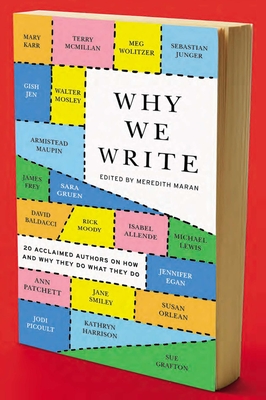
Book Review: Why We Write, edited by Meredith Maran

Anyone who has ever stared at the accursed cursor blinking on the blank page of a computer screen knows how frustrating the writing process can be. But there are those who dedicate their lives to it, and all of the joys and frustrations that come with it.
"We fill our journals and write our novels and take our writing classes. We read voraciously, marveling at the sentences and characters and plot twists our favorite authors bestow upon us. How do they do it? we ask ourselves. And why?"
This is the question, or set of questions, that editor Meredith Maran set out to answer in Why We Write: 20 Acclaimed Authors on How and Why They Do What They Do, though ultimately the collection answers  many more besides. The twenty authors here, all successful and known to the literary community, offer a wide array of voices, adding the voices of contemporary writers the canon of Hemingway, Miller and Kerouac quotes on writing that grace the pages of Pinterest these days.

Perhaps not surprisingly, there are certain themes that emerge as these writers talk about their craft:

They write because they have to, because there is an itch there that needs to be scratched ("The only thing that makes me crazier than writing is not writing." -Sara Gruen).

They write in an attempt to answer important questions about the world ("The unwritten sentence--perhaps that will be the one, the one that makes life comprehensible, the one that reveals the beauty & order under what can sometimes seem like a landscape of chaos and cruelty." -Kathryn Harrison).

They write through the uncertainties of the publishing industry. They write through their own insecurities. Is the last book I wrote my last book, they all seem to wonder? Will I run out of ideas? Inspiration? Words? Time? Focus? Will my next book be successful? Will anyone read it? Will they like it?

Most entertaining in Why We Write is the chance to go behind the pages of the books we know and love--or perhaps, the pages of books as-yet unknown to us--to meet the authors that gave them to us. What we find there is often surprising. Sebastian Junger recalls the number of readers astonished to learn that he was 5'8", having imagined him to be 6'3". "What was it about my book that made me tall?" he asks. Do we really know the writers we love so much? we wonder in response. Ann Patchett notes her adversity to writing rituals and habits, noting, in her characteristically dry way, "When you're a writer, it's so easy to become a freak."

Why We Write is a collection that can be taken piece by piece or read as a whole, sorted by author or genre or age at the readers' whim. Some writers seem to reveal themselves with a chip on their shoulders. Others veer so strongly from taking their work too seriously as to seem flippant. Some talk of the challenges of racism and sexism in the publishing industry. Most talk of the utter shock they first felt when realizing that their words were printed and bound and available for the world to read, and the struggle to balance writing with the rest of their lives, and the need to keep writing even when the writing is not going well.

These twenty essays contain enough inspiration to spawn an entire library of novels, a database of articles, and a bookstore of non-fiction titles; even for those not planning to write a book themselves, though, the insights into the writing process are full of promise and interest. Whether a writer or a reader be, Why We Write is a delightful romp through twenty worlds of twenty writers, condensing into moving tidbits about the power of dedication and hard work to bring something beautiful into the world--ultimately, a true expression of the person who gave it life:

"No one can take writing away from you, but no one can give it to you, either." -Meg Wolitzer

---

Why We Write is on sale today from Plume. The twenty writers included in Why We Write, in alphabetical order, are: Isabel Allende, David Baldacci, Jennifer Egan, James Frey, Sue Grafton, Sara Gruen, Kathryn Harrison, Gish Jen, Sebastian Junger, Mary Karr, Michael Lewis, Armistead Maupin, Terry McMillan, Rick Moody, Walter Mosley, Susan Orlean, Ann Patchett, Jodi Picoult, Jane Smily, Meg Wolitzer.

---

Note: Thanks to the publisher, Plume, for providing an e-galley of this title for review via NetGalley.
Why We Write | Meredith Maran, ed. | Plume | Paperback | January 2013 | 256 pages | Buy from an independent near you

The Novel: Live!

Have you heard about this? It's been buzzing around the bookish interwebs for a few days now, but for some reason I just had the time to actually read through an entire article on it (in today's Shelf Awareness). The project includes 36 authors, one Nancy Pearl, six days and a to-be-written novel. And the best part? The public is invited to watch this amazing feat, either live, at the Hugo House in Seattle (complete with happy hour drink specials!), or online at www.thenovellive.org.

While this is certainly not the first collaborative book-writing effort we've seen of late (remember the 24-hour Book from last year, and the Twitter book with Neil Gaiman?), it certainly stands out among the crowd. Here's a little preview:


According to Shelf Awareness, "the book is not a weather report, and the heroine, Alexis Austin, is a brave 14-year-old coping with death and a few other things that a young girl shouldn't have to deal with."

Intrigued? Read the first half of the novel online, and tune in from 10am-10pm (Pacific time) to watch the progress. Join the live chat each evening to bid on fun merchandise (such as signed books and homemade pickles) - proceeds go to Seattle Arts & Lectures' Writers in the School Program and 826 Seattle, a non-profit writing and tutoring center for students in Seattle.

And need I remind you to stay tuned for the final product, due 10/16?

Do You Tweet?

Last year, I gave up arguing and, quite reluctantly, started my Twitter account (@ofabookworm) . Our publicist asked me to sign up to see who's talking about books, and who we could get in touch with about possible reviews of some of our titles (yes, tweeters, publicists and marketing people use Twitter research to find that kind of information).

I've since grown into my Twitter rather slowly. I'll post frequently for a day or two, then wane off as I get distracted. But even with my limited use - something I'm aiming to improve, with the help of HootSuite - I am astounded at some of the connections I've made. I've identified a few possible review outlets for our books, sure. Beyond that, though, I've "met" some great, book-loving people, discovered wonderful articles about books and book-related things, and even gained a few followers in the process.

It's more than just a platform to talk about what you had for breakfast, or whine about some inconvenience of the day. Of course, people do use it as such a platform, but the solution to that is simple: don't follow them.

Author J. Robert King, who writes for Angry Robot, argued the case for Twitter quite well in his recent blog post, which brought all of this to the forefront of my thinking. So if you've been thinking about tweeting, I'd like to add my argument to King's and say it's worth a shot, whatever your motivations. With over 1 million users, you are guaranteed to find a group that's worth your time.

Writer Spotlight - Shel Silverstein

Today is Shel Silverstein's birthday - it would have been his 79th. He is the author and poet of many of the beloved child stories and poems we know and remember fondly: Where the Sidewalk Ends (1974), Light in the Attic (1981), Falling Up (1996), The Giving Tree (1964), The Missing Piece (1976)... the list goes on. To say that he work was prized is an understatement: A Light in the Attic alone won 9+ awards, and remained on the NYT bestseller list for over two years.

But Shel Silverstein was in every sense of the word a Renaissance man: singer, songwriter, poet, children's author, cartoonist. He studied music and composition briefly, and his songwriting credits include the soundtrack to A Boy Named Sue, various songs for Johnny Cash, and several hits for Loretta Lynn and the Irish Rovers.

He first started drawing cartoons for the Pacific Stars and Stripes as a GI in Japan during the Korean War. His work was later featured regularly in Playboy Magazine, and connections to a friend in children's publishing led to his first children's book, The Giving Tree. The rest, as they say, is history.