Showing posts with label authors. Show all posts

Lyndsay Faye, Sherlock Holmes and The Whole Art of Detection


I'm a long-time fan of Lyndsay Faye's work: her Timothy Wilde trilogy rang all my historical fiction bells, and I loved the cleverness of Jane Steele. And so it was an honor to be able to interview her about her newest book, The Whole Art of Detection, a collection of Sherlockian stories that perfectly capture the essence of Doyle's original tales:

---

Interview with Lyndsay Faye


Lyndsay Faye has been reading Sherlock stories since she was 10. "I loved them," she says, "and then I never actually stopped reading them. Lacking the Internet, it wasn't until I was a teenager that I discovered there was such a thing as pastiches and fan fiction out there. Then I read as much of the non-canonical material as I could find--probably thousands of stories at this point, no joke." 


---

Review of The Whole Art of Detection


The 15 stories in Lyndsay Faye's The Whole Art of Detection will prove purely delightful for fans of the original adventures of Sherlock Holmes and Dr. Watson. With two entirely new stories, and 13 others culled from previous anthologies and magazine contributions, the collection stands as a tribute to Faye's way with words and witticisms, both of which combine to reinvigorate Holmes and Watson (as well as their surrounding casts of miscreants, assistants and unassuming bystanders).

Social Justice Book Club: Q&A with Sonia Nazario


Sonia Nazario, author of Enrique's Journey (the March pick for the Social Justice Book Club) answered a few club questions for us to add on to the discussion of her book (see my recap of the month here).

Social Justice Book Club: Q&A with Author Laura Tillman


The Social Justice Book Club is a bi-monthly online reading group that reads books focused on social justice issues. For the month of June, we selected The Long Shadow of Small Ghosts: Murder and Memory in an American City, by journalist Laura Tillman. Below, Tillman talks about the book, what it was like to write it, and recommends some other social justice books. Thanks to all who contributed questions this round!

(And don't forget to link up to any discussion or review of the book in the June Social Justice Book Club Link Up post over here.)


In the introduction, you write about the fact that because the victims of this crime were children, and because an explanation was never reached, those impacted found themselves questioning everything they knew about their community. Do you think that is the case with all crimes against children? All crimes that cannot be, somehow, rationally explained?

That's a good question, and one that's hard for me to answer. I would imagine there is some element of disillusionment and confusion whenever a crime against children occurs - it's hard to wrap your mind around how someone could victimize a child, who is innocent and totally vulnerable. I do think that there is a difference, however, in the way a community reckons with distinct events. In the case of Brownsville, many crimes had happened, many involving children. And yet, not all left the same impression as this one. I think the building is partly responsible for the way people continued to mull this crime over, and, in so doing, how it squared with their perceptions of justice and morality.

Week in Reading: August 31st


Does the last day of August make it the last day of summer? Based on the current forecast for my beach vacation, the weather gods must think so:

Luckily there's a section of covered porch here overlooking the water, so rain or no rain, I'm curling up with a stack of books this week. Despite my hopes of focusing on backlist on vacation, deadlines loom, so I'm picking up a few upcoming releases (My Year of Running Dangerously and 2015 Best American Science Fiction & Fantasy). I'm also eying the new Margaret Atwood book, because NEW MARGARET ATWOOD BOOK (I'll count this for my book written by an author over the age of 65 in the Read Harder challenge) and finally getting to What I Talk About When I Talk About Running, which has been on my list for what feels like years.

---

What are you all reading this first week of September?


When Maureen Corrigan & Ann Patchett Talk on Stage, They Recommend Books


One of the things I'm love-love-loving about my new hometown is the bookish community that lives here. I've joined two book clubs and gotten to know some of the staff at the ever-incredible, well-curated indie in town, Curious Iguana. I've joined the (very large) public library. And this week, I attended the kind of author event I've always longed for without knowing what I was longing for: Ann Patchett (indie bookstore owner and bestselling author of such novels as Bel Canto and State of Wonder) and Maureen Corrigan (NPR anchor, book reviewer, and author of last year's So We Read On) in conversation.

This wasn't an "author talk." Patchett and Corrigan are friends (a fact that Patchett seems thrilled about, and yet disappointed because it means Corrigan won't review any of her future books), and so watching the two on stage, tucked in wingback armchairs, discussing books and storytelling and writing and privilege and imagination was like watching someone's afternoon tea time, only with an audience.

Patchett and Corrigan were charming and interesting and witty and bold; I expect that some of the questions they raised for each other (Is there a limit on what an author can right about? Can Patchett, for example, write about the African-American experience?) will continue to stew in my brain and ultimately become fodder for a future post. But in the meantime, I figured I'd share with the world the books they mentioned specifically and recommended to the audience*:

An Interview with Laurie King: Inspired by Sherlock Holmes

This interview originally ran in Shelf Awareness for Readers. Reprinted here with permission.

---

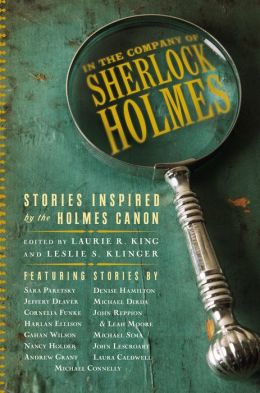
Laurie King is the author of more than two dozen crime and mystery novels, including the Mary Russell series, inspired by Sherlock Holmes. She was inducted into the Baker Street Irregulars in 2010. King worked as co-editor, with Leslie Klinger, on the story anthology In the Company of Sherlock Holmes (Pegasus), the second volume of Holmes-inspired stories the duo has worked on (the first was A Study in Sherlock, published in 2011).
---
Both anthologies (In the Company of Sherlock Holmes, 2014, and A Study in Sherlock, 2011) take an unorthodox approach to collecting Sherlock Holmes stories. Where did the original idea came from, and how that has shaped the collections?
It all started because Leslie Klinger suggested to the organizers of [the mystery convention] Left Coast Crime that he and I do a panel on Sherlock Holmes with people who aren't normally connected with Sherlock Holmes (Lee Child, Michael Connelly and Jan Burke). We had a great time with the panel itself, and afterward, he and I looked at each other and said, "Hey... I know what to do with this."
So we started asking people to contribute to an anthology. From the beginning, we looked for writers you don't think of as Sherlockians. With the exception of Neil Gaiman, who had written an earlier Holmes story, most of the authors that we have in the collections have never published something to do with Sherlock Holmes. That has really lent both collections an energy of newness.
Since you weren't looking for known experts on the Holmes canon for In the Company of Sherlock Holmes, how did you go about selecting the contributors?
Some of them were people we met at a party or conference who said how much they enjoyed the first collection, so we asked them to be in the next one. For the rest, we started with a core number of people who we knew we wanted to include in the second volume, and from there we spread out trying to get a balance in flavor and style.
How much direction did you give the contributors about the types of stories you wanted?
What we said was that anything inspired by the Holmes canon would work, so long as it was vaguely connected to Sherlock Holmes. And then we stood back. That was the shocking thing about this process: seeing what a first-rate, professional writer could do with an absolutely free slate.
The only time Les and I stepped in during the writing process was to answer questions about some Sherlockian detail, like where a certain character is in a given story. We functioned as a kind of resource for the contributors. As editors, we also made suggestions on how the stories could be tugged closer to the Sherlock canon, or made a bit tighter.
The range of style--from graphic story to a play on a series of Facebook posts--is as diverse as the time periods included in these stories.
In any collection inspired by Sherlock Holmes, you expect to get things set in the Victorian era, or modern-day adaptations of the stories. Then there are stories in this collection like "Dunkirk," which shows that John Lescroat had clearly done a lot of research on the battle, and in looking for a way to use that exciting material in a story, asked himself how old Sherlock might have been in 1940. When he realized it could work, he brushed off the older Sherlock Holmes and saw what he could do at Dunkirk.
There are many clever nods to the original Holmes stories throughout the whole collection. Do readers need to be familiar with the original canon to appreciate the stories?
I think it's like many reading experiences: your background can enrich a book, but any fiction that requires a certain background is, I think, not a valid form of fiction. The story has to stand on its own.
It's also one of the advantages of choosing writers outside of the Sherlock community, as it were; they realize that not everyone speaks the "Sherlockian" language.
It's impossible discuss In the Company of Sherlock Holmes without asking about the "Free Sherlock" campaign, which resulted in a court ruling that Sherlock is now in the public domain. What was it like, being at the center of legal dispute over one of the most popular characters in literature?
I was somewhat removed from it, because it was more Les's thing, but, obviously, because it was sparked by a book that I was one of the editors for, I was involved. He had just decided that this assumption of possession of the first 50 stories on the part of the Conan Doyle estate was generally accepted--but flawed.
In the first volume, the issue of copyright was got around by paying the estate; over our objections, our first publisher's legal department decided it was simpler to pay for the usage. And indeed, most of the film companies have decided the same--that it's easier just to pay the Estate. But Les said no--they don't have the right to do this. He's a lawyer, and he felt they had no right to claim this character.
In the introduction of In the Company you wrote that you were already planning this second volume before you had even completed the first. Does that mean a third volume is already in the works?
Oh, yes. Les already has a list going. We have a conference coming up, and we're working on a list of people we can shoehorn into a corner and ask to write for us. These collections are just so much fun.

---


A copy of this title was provided by the publisher for review.
In the Company of Sherlock Holmes | ed. Laurie King and Leslie Klinger | Pegasus Books | 2014 | Buy from an independent bookstore near you


A copy of this title was provided by the publisher for review.
A Study in Sherlock | ed. Laurie King and Leslie Klinger | Poisoned Pen Press | 2011 | Buy from an independent bookstore near you

Authors That Take Up the Most Space on My Shelves

I own a lot of books (something like 28 boxes in storage, give or take a few hundred more tomes in my current apartment). Some are galleys, some are carefully curated selections. Most are by different authors, but there are a few writers that dominate a disproportionate amount of space on my shelves/in my boxes/on my Nook:


J.K. Rowling, 10: All seven Harry Potter books, of course (the hardcovers in the boxed suitcase-like set), plus a few scattered old paperback editions of the earlier titles in the series. Plus A Casual Vacancy and the first Robert Galbraith book, and that makes 10+.


Ernest Hemingway, 11: I long ago decided to try to sit down to read everything Hemingway has ever written, and while I'm still far from accomplishing that goal, I've got a good collection going: The Old Man and the Sea, two editions of The Short Stories of Ernest Hemingway, Islands in the Stream, To Have and Have Not, The Sun Also Rises, For Whom the Bell Tolls, two editions of A Moveable Feast, a second e-book version of The Sun Also Rises, The Snows of Kilimanjaro. That's 11, and since I'm doing this from memory, I think I missed a few. (Bonus points to Hemingway because of the many Hemingway-themed reading I have, including Hemingway's Boat, Hemingway's Girl, The Paris Wife, and Mrs. Hemingway.)


F. Scott Fitzgerald, 6: I'm a sucker for a pretty edition, and Coralie Bickford Smith's decadent volumes of Fitzgerald's works are no exception. In addition to my battered old paperback copy of The Great Gatsby, which has survived the decade+ since I first read it in high school, I have two of Fitzgerald's novellas from Melville House's Art of the Novella series, The Beautiful and Damned, This Side of Paradise, and Tender is the Night. (Bonus points to Fitzgerald because I own two novelizations of his wife's life, Z and Call Me Zelda, plus two Out of Print Gatsby-themed shirts.)


Margaret Atwood, 6: Oh Margaret Atwood, how I love thee. On my shelf: the Maddaddam trilogy, The Handmaid's Tale, Cat's Eye, Alias Grace.


Robert Jordan (and Brandon Sanderson), 15: I've written before about my undying love for Robert Jordan's Wheel of Time series, and with fourteen volumes in all, let's just say this dominates my shelves. (Doesn't hurt that I own two copies of the first book in the series, Eye of the World.) On top of that, my husband and I collectively own most, if not all, of Sanderson's other works.

---


This post is part of Top Ten Tuesday, hosted by The Broke and the Bookish.

Guest Post: Ben H. Winters Recommends Mystery Books for Aspiring Writers

I recently read (and adored) Ben H. Winter's Last Policeman trilogy (see my reviews of The Last Policeman and Countdown City, as well as the final volume, World of Trouble, on sale this week). So when the publisher, Quirk Books, asked if I'd be interested in participating in a blog tour with Winters, I couldn't resist. Below, find Winters discussing his #fridayreads picks for aspiring mystery writers. And if you're interested, you can check out all of Winters' other tour stops over on the Quirk blog
If you haven't already read the trilogy, you can also enter to win all three of the books, courtesy of Quirk Books, by filling out the form here.

YOU READ FOR A WHILE, AND THEN YOU WRITE, by Ben H. Winters


I frequently say that the best way to learn to write a book is to read a lot of books. It’s kind of a cheap and useless piece of advice, though, isn’t it—because first of all I think probably everybody who wants to write a book has already figured that out (although every once in a while you meet an aspiring writer who says something like “I don’t really like to read that much,” which is pretty astonishing).

And then also the obvious question is, “Any books in particular?”

So let me see if I can make some suggestions. Here are a bunch of books that will not in and of themselves teach you how to write a mystery, but which I know I am a better writer because I have read them.

The first thing you want to do, actually, is read this short opinion article by Lee Child, the guy who writes all those Jack Reacher novels. He will explain to you that your primary job is NOT to create interesting events and secrets, that’s the SECONDARY job. The PRIMARY job is is make the reader wait, so they are so eager to get to the interesting events and secrets that they fall into that intense feverish state we call the pleasure of reading.

Get that, and then read Agatha Christie’s The Murder of Roger Ackroyd, greatly and justly acclaimed as a Golden Age masterpiece; when you are done and have recovered from the shock of the final chapters, go back and read it again, noting those precise moments where information is omitted, or presented wrapped in veils or buried in a maze of misdirection.

Then you gotta read Who Killed Roger Ackroyd?, by the French psychoanalyst and literature professor Pierre Bayard. Engaging with Bayard’s cerebral (and at times maddening) book-long dissection/celebration of Ackroyd isn’t fun, exactly, but the guy points to and explains all of Christie’s tricks—it’s like the part of a Penn & Teller show where they go, “Okay, here’s how we did it…”

Then go ahead and read Hammett’s The Maltese Falcon, which besides being the progenitor of a thousand hardboiled crime novels set on a thousand rainswept streets, is another wickedly deceptive piece of work. Details hide between sentences, they are flashed at us like the bottom card on a deck and then tucked away before we can process them.

Lots of brilliant books (not to mention lots of tedious parodies) can point to Falcon as a big influence; two to read, for sure, are James Ellroy’s The Black Dahlia and Michael Chabon’s The Yiddish Policeman’s Union. Note how both of these guys, in very different ways, take the cool steely surface of the Falcon and pry it open, show how much is going on beneath, in the anxious minds and wild hearts of the detectives.

But the novel that can teach you the most—not only how to deceive and delay, but also how to give the reader real human characters with real human hearts—is Clockers, by Richard Price. For my money, that’s the finest crime novel out there, because it so successfully marries the imperatives of the genre (solve the puzzle! Trick the reader!) with the imperatives of all great art: make us believe, make us care, challenge our expectations about ourselves and about other people.

There are pieces of all these books, influences of all of them, in The Last Policeman and its sequels. But hopefully I absorbed the lessons of the genre and then I made it my own. That’s how you do it, ultimately, you take what you can, and you go. You read for a while, and then you write.

---

What are your go-to mystery reads? And what books would you recommend to aspiring writers?

Julia Dahl: The Power of Journalism

Originally published in the May 13, 2014 issue of Shelf Awareness for Readers. Reprinted here with permission. If you don't already receive it, sign up here to receive a bi-weekly dose of readerly goodness in your inbox.


photo: Chasi Annexy
Julia Dahl is a journalist and author specializing in crime and crime fiction. She has written for the New York Post and CBSNews.com, and her articles have appeared in Mental Floss, Salon and The Crime Report. Invisible City, her first novel, is the story of a young journalist in New York City reporting on the murder of a Hasidic woman in an ultra-Orthodox community in Brooklyn (read my full review).

Invisible City is your debut novel, but you have written extensively about crime as a journalist. How was writing fiction about a crime different from writing a news piece about a crime?

I think one of the things I enjoy most about writing is writing dialogue, and you don't get to do a ton of that in crime journalism. You can quote people, obviously, but when writing a piece about a crime, you weren't there. I swoop in after the crime happened and try to piece together the story from a number of sources--but I'm never really on the inside. I only know somebody from what they show me. In fiction, I get to know people from the inside, because I'm the one creating them.

What most surprised you about the novel-writing process?

How difficult it was to make the plot work. I write a lot of day stories--this is the murder, this is the charge, this is the detail we have. The length between start and finish is very short. But here, I wanted to create a plot that would keep people turning the pages, but also feel authentic. I didn't want readers to stop and think, "What? How did we get here?"

So at the beginning of the book, I knew "whodunit," and I had sense of why, but I didn't know how I would get there at all. A lot of that came in the re-writing.

Rebekah Roberts, the main character in Invisible City, works as a stringer for the New York Tribune; she is sent to various scenes across the city to collect details and call them in for another writer. Why did you decide to make Rebekah a stringer rather than a journalist?

That's just how it was, and still is as far as I know, in New York City tabloids. They're called different things--stringer, runner, reporter--but all are sent somewhere to call in information, which was really shocking to me when I first started. My first day at the New York Post, I was sent to an accident scene. I went and I interviewed people, and then I typed up a story and e-mailed it in, which shocked my editors. That was not how it worked. There were people in the office that did the writing; I did the fact-gathering. That got me thinking about ethics in journalism and how things might get printed that aren't quite accurate, because there is this chain of people involved.

So partly Rebekah works as a stringer because that's how it would happen and it felt authentic. I also hope that it pushes readers to ask questions: Is that how it really goes? Is that the right way to do this? The best way to honor the truth?

As Rebekah pushes to uncover more information about a murder that others--including the police--seem to be inclined to let alone, she seems shocked at the power she has to keep a story alive.

One of the other things that was important to me in Invisible City were the perils of being a young journalist without any guidance, especially in the tabloid world. Rebekah's only experience before this job is with the school paper. Now she is writing for a paper with a million readers every day, even if they do take the stories with a grain of salt or read them for entertainment. And there is a tremendous amount of power in that. Journalists and editors have a responsibility to think about the impact of what they are printing has on the people reading it. In this case, Rebekah is forced to start taking her job seriously.

How did your own religious background influence the character of Rebekah, who, like you, comes from parents from two different religions?

You write what you know, a little bit. I've spent a lot of my life actively thinking about religion and where I fit. As a child, I went to church and I went to synagogue, and I got to choose which religion was for me. So some of things I'm working out in my head as I write are about what it's like to live between two religions.

Though you are Jewish, you are not ultra-Orthodox. Why did you explore the ultra-Orthodox?
There are probably close to 200,000 ultra-Orthodox in New York City, and an even larger community outside of New York, upstate and in New Jersey. The average family size is four to five kids. And it was, especially before I moved to New York, a community I knew very little about.

Right when I had just started working for the Post, I moved into an apartment whose previous occupant had committed suicide. I found out that he was an ultra-Orthodox man who had had a family and worked as a teacher, but had been shunned because it turned out he was gay. I would get his mail, and though I never opened it, I started to build an idea of this person in my mind. And right on top of that, I was assigned to a story of an ultra-Orthodox groom who had killed himself right after his wedding.

All of that together just made me want to know more, especially because I thought how like me they are--they're Jews! But then, the thing that I value the most in my life is freedom, and it occurred to me that these are people who grow up with no freedom. I wanted to explore that.

Do you have any recommendations for other books about the ultra-Orthodox community?
The first book I read, and the one that was the most revealing for me, was called Unchosen: The Hidden Lives of Hasidic Rebels by Hella Winston. It is nonfiction, centering on a handful of people who grew up ultra-Orthodox and are attempting to leave in some way.

Speaking of further reading, I understand this won't be the last we see of Rebekah Roberts.
Soon after I finished Invisible City, I knew I had to write more about Rebekah. I've just finished the draft of second book, which is scheduled to come out next year. It takes place soon after the end of Invisible City, and Rebekah is still a reporter in New York. Rebekah's mother is a big part of the second book. I'm so happy that I get to write this character again.


Interview with Kevin Brockmeier: A Difficult Year

Originally published in the April 11, 2014 issue of Shelf Awareness for Readers. Reprinted here with permission. If you don't already receive it, sign up here to receive a bi-weekly dose of readerly goodness in your inbox.

---

Kevin Brockmeier is the author of many works of adult and children's fiction, including The Illumination, and several short story collections. His stories have been published in the New Yorker, McSweeney's and Tin House, and he has received the Borders Original Voices Award, three O. Henry Awards and the PEN USA Award. In 2007, he was named one of Granta magazine's Best Young American Novelists. He teaches at the Iowa Writers' Workshop, and lives in Little Rock, Ark., where he was raised. His first memoir, A Few Seconds of Radiant Filmstrip (see my review below), focuses on a particular period of his life--the seventh grade.

Because so many people cannot recall the seventh grade with any kind of fondness, I have to ask: What made you want to go back to revisit it?

First, that it was a difficult year. For that reason alone, I thought it might make a good story. I also realized I had a lot of stories that I had been telling people since I was 13 years old, and I could pinpoint them all to that time in my life.

I had also never written book of this sort, and wanted to see if I could do it.

This is one of the only memoirs I can recall reading that is written in the third person. Why did you ultimate decide on this approach, when first person seems the more obvious choice?

I attempted the very first paragraph of the book in any number of ways. I ultimately found a voice that allowed me access to that period of my life with specificity. In the third person, the voice of Kevin felt natural. I felt the consciousness that I used to possess at that time blossoming to life, and I wanted to explore that.

At the time, were you aware of any split within yourself, being so observant of other people but struggling to see how you fit into that changing landscape?

I probably was. What surprised and distressed me at the time was the way in which my friendships shifted off in new directions that didn't include me. I was aware of the nuances of those relationships day by day. I just didn't see where it was all going.

A lot of this book is about friendship, and how yours changed over the course of the seventh grade.

Most of those friendships faded over the course of the year. I had a little trio of friends: Thad and Kenneth and Bateman. Bateman remains a friend of mine. I was closest with Thad and Kenneth, but they were no longer a presence in my life by the time the year was over.

That was a difficult year for me, but there were a few people in my life then who were kind and generous and made the year much easier than it otherwise could have been. One of them was Ethan Carpenter, who slowly becomes my best friend over the course of the book. And the other one was my English teacher, Miss Vincent.

You thank every member of your seventh-grade class in your dedication, but Miss Vincent is the only teacher you've included.

Miss Vincent was only at CAC that one year. Every so often I would think about her, where she was, what she had become. But she was a grown-up and I was a kid; there was really no way of staying in touch back then. And I don't even know that I was sure at the time how important she was to me. It was only when I was writing the book that I realized how fundamental of a presence she had been that year, and how intimately involved she was in what happened to me.

Did you ever speak to her again?

I had tried in the past with no luck. But after I finished writing this book, I tried again. I ultimately found someone teaching English in Washington State. She had a different name, hyphenated, but it seemed worth a shot. I sent her a letter, and included a copy ofThe Illumination. I just said who I was, where my life had taken me, and that seventh grade was an extraordinarily difficult year for me. I told her she was kind, and made it easier than it might have been, which was something I hadn't been able to express at the time, but wanted to express now.

I heard back from her a few weeks later. I had found the right person, and she remembered me--a bit surprising giving the years and number of students she had taught, but then, I had written a play about her. We ended up getting coffee when she was in Arkansas visiting family.

There's a section in the middle of the book that feels more fantastical than one might expect in a memoir. Can you talk about that?

I thought of that chapter as a moment of science fiction in the middle of what is otherwise a wholly autobiographical endeavor. Within the world of the narrative, I wanted it to be understood as something that this character is undergoing. But as readers, we understand that this is a device employed as a writer, rather than an actual memorable feature of my experience. It was an opportunity to divorce Kevin Brockmeier from the events he was undergoing, talk about what would happen to him, and give him an opportunity to accept his life, with all of its difficulties.

It's definitely unusual, but intentional. And because that element is in the memoir, it is more in keeping with my novels and short stories.

In an age when bullying is a hot topic, what advice would you have for kids in a difficult spot--or for their parents?

The closest I could come to advice would be acknowledging you aren't the only person who has gone through these experiences. I underwent them, too, I understand what it's like. I'm hesitant to say that things will get better, because who knows? But I can say unequivocally that things will change. It won't always be like this. It's so hard to imagine who you will become. 


Thank-You Notes for Writers

In college, I was lucky enough to spend a semester studying in Paris. About a month into my stay, I found myself frustrated with the French, and France, and my entire program, generally missing home and wondering what in the hell I'd gotten myself into. I had cheese and Nutella and wine and the company of a best friend, but I was cold, I missed my family (and the sun), I stepped in dog poop in the sidewalk at least once a day, and I was learning first-hand how little the Parisians wanted to help me with my French. 

In front of Shakespeare and Co.
When I came across a battered copy of A Year in the Merde in a used bookshop in the city, imagine my delight at finding that Stephen Clarke had had all of the same troubles I was having at that very moment:
Dear Mr. Clarke, I just wanted to say thank you for A Year in the Merde.  I just moved to Paris, and I will be studying here for the next semester. I have not enjoyed Paris as much as I had expected to - the French and I just don't see eye-to-eye - but your book took everything about France and the French that drives me insane and, magically, made it laughable and humorous.  I laughed so much while reading your book, and afterwards when experiencing things that you wrote about, and I just wanted to let you know how much I enjoyed it and how much of a difference it made knowing I am not completely insane in my thoughts here.

Thank you,
Kerry
And his response, which came only a few days later, made my day:
hi,
glad you enjoyed the book. you do know there's a
volume two called merde actually, don't you? it might
help you continue your laughotherapy.
like uranium and tobacco smoke, prolonged exposure to
france can cause lasting damage.

bonne lecture
sc
I've since come to appreciate my time in Paris, even going so far as to say I miss the place sometimes, but it was a harder transition than I ever could have anticipated. Stephen Clarke's words--in his book and in his email--let me know I wasn't alone in my struggles to appreciate the City of Light. How could I ever thank him enough?

Last day in Paris, at the top of the Eiffel Tower.
Or as far up as we were allowed to go that day, anyway.

Have you ever written a thank-you note to a writer?

---

Over at Go Mighty, you can sign up to join the Mighty Girl community and participate in the #thankawriter project. Bonus: For every #thankawriter submission, you'll be entered into a competition to win a set of Penguin's adorbs Drop Cap classics. I'm not participating or in anyway affiliated with the contest, but figured it was worth a share for anyone interested in thanking a writer and potentially winning some really lovely books.

Reading with Author Blinders On

Remember that kerfuffle last summer over certain female authors complaining that certain male authors got more publicity than them? Or, in fact, that in major news outlets, male authors are consistently favored over female authors? Remember last week when said kerfuffle made a re-appearance?

I'm not out to voice opinions on one side of said kerfuffle or the other. I think both sides have merit, and I think one of the beauties of social media and the blogging network is that everyone gets to have--and voice--an opinion. (I do wish we could all play nice, however, as said kerfuffle sometimes gets hackles raised.)

While I am no major literary news outlet, said kerfuffle got me thinking about my own reading preferences. Do I read more male authors than female? I'd never really thought about it. Turns out I do: in 2011, I read 43 books written by male authors compared to just 29 written by females.

In order to know that number, I had to create the worlds nerdiest spreadsheet to tally my reading statistics. (In case you're interested, I also read 49 print books and 3 e-books and listened to 21 audio. I started 8 books that I did not finish, and 7 of the books on my list this year were re-reads.) The fact that I had to look at cold hard statistics in order to glean the fact that I trend toward male writers says one very important thing to me: that these decisions were not conscious. At no point in time did I stop and think to myself, "That book is written by a female. I should read it." (Or the inverse, of course).

Naturally, when I read a book like Gilead, which was written by a woman but narrated by an aging male priest, or Letter to My Daughter, which was written by a man but narrated by a mother, I often comment on the skill of the author in pulling off so completely a voice so foreign from their own experience. But these are observations on completed books, rather than deciding factors in what to read.

I select books by the cover, by word-of-mouth, by subject, by back-cover blurb, by captivation of the first chapter, or by opening the book at random and selecting 10 pages to read. I read books that are recommended to me, whether by fellow bloggers or by friends and family, books that are given to me, and books that are loaned to me. Rarely, if ever, does the gender of an author play a part in my decision to read a book. I think about my next read in terms of the language it will present, the subjects and themes I will encounter, the setting and the experience of reading it. These things, of course, are shaped by the author, but examples like Gilead and Letter to My Daughter are written proof that the author's gender and own life experience are not limitations for a book. The book, ultimately, stands on its own, apart from the author that created it.

I know I may be alone in this sentiment. I know there are bloggers out there who make a point to read more female writers, or non-white authors, or authors who are not from the United States, in order to keep their reading well-rounded. I commend that dedication. Really, with such a wealth of literature to choose from, selecting books by a set of specifications is challenging (just look at the long list of books that didn't meet my 2011 reading goals and you'll see what I mean).

So what about you? Do you read based on author attributes? Do you have reading goals or participate in challenges to meet these goals? Am I the only one who reads with author blinders on, or are there others out there like me?

With that, I'm off to spend Sunday morning with a new book. I haven't yet decided what it will be, but I will be picking based on the book, not the gender of the author that wrote it. At least consciously--I'll leave it to Freud to analyze what all of this says about my subconscious.

Author Adoration

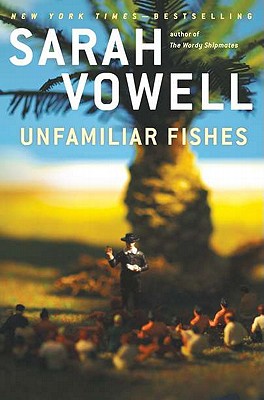
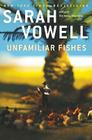
I'm about halfway through Sarah Vowell's Unfamiliar Fishes, which according to the back cover is "an examination of Hawaii, the place where Manifest Destiny got a sunburn." I love history, but in the grand scheme of historic subjects, the history of American imperialism in Hawaii does not strike my fancy. Sarah Vowell, however, does.

I devoured The Partly Cloudy Patriot, her account of her on-again, off-again love affair with American patriotism, and absolutely loved Assassination Vacation, in which she documents her travels to various places related to presidential assassinations. Vowell is witty, humorous, nerdy, educated, and obsessed with the trivial details we are generally all too willing to overlook. I don't need humor to find a history book interesting, but man, do I appreciate it.

So when I was offered a review copy of Unfamiliar Fishes, I did not hesitate in accepting, even though a part of my brain was saying, "Hawaii? Ugh. American imperialism is so overrated."

I accepted the book not as a standalone object that I thought I might enjoy, but as part of an author's repertoire that I know I have enjoyed. In short, I'd read anything Sarah Vowell decided to write.

All bookworms have favorite authors, of course. But do you have an author whose next book you will read, regardless of subject? In addition to Sarah Vowell, I have a few others: Mary Roach (whether she's righting about cadavers or sex or outer space, I'm interested), Mark Helprin, and Gabriel Garcia Marquez. To me, these are authors whose writing is so accomplished that they can take any subject, any story, and turn it into something I want to read. Something I want to own, so I can read and re-read. They are vastly different, each of them, but they can be assured of at least one purchase of each of their next books by yours truly.

What about you? Do you pick books as standalone objects, or as part of an author's repertoire? Do you have authors whose books you will read, regardless of subject, or are you more focused on the subject matter?

Book Blogger Hop: My Favorite Authors

It's Friday, which means Book Blogger Hop (thanks to Crazy-For-Books for hosting).

Because the Hop posts are on Fridays, this also means I'm going to start moving my "Great Friday" (wherein I provide links and pictures of great book-related stuff, i.e. Great Bookmark Friday, Great Bookends Friday, Great Book Purses Friday, and today's Great Planter Friday) to another day.

But I digress. Welcome to any new visitors from the Hop, and to old visitors - thanks for stopping by! This week, hoppers are asked to talk about their favorite authors. Mine rotate on a weekly, if not daily, basis, so this is particularly difficult, but for now:

1) Gabriel Garcia Marquez - in part because his writing is beautiful, poetic, and poignant, and in part because the first book my now-fiance, then "just friend," lent me was Love in the Time of Cholera.

2) Mark Helprin - also because his writing is beautiful, poetic, and poignant, and because he manages to weave magic with the everyday and turn the world around us into an inspiring, awesome place, all with carefully chosen words.

3) Justin Cronin - because I just finished The Passage and I CANNOT STOP GUSHING OVER IT.

4) Mary Roach - because she always, always, always makes me laugh, regardless of subject matter. I reviewed Bonk a while back, if you'd like to see more of my thoughts on this.

Happy Almost Weekend!

Do You Tweet?

Last year, I gave up arguing and, quite reluctantly, started my Twitter account (@ofabookworm) . Our publicist asked me to sign up to see who's talking about books, and who we could get in touch with about possible reviews of some of our titles (yes, tweeters, publicists and marketing people use Twitter research to find that kind of information).

I've since grown into my Twitter rather slowly. I'll post frequently for a day or two, then wane off as I get distracted. But even with my limited use - something I'm aiming to improve, with the help of HootSuite - I am astounded at some of the connections I've made. I've identified a few possible review outlets for our books, sure. Beyond that, though, I've "met" some great, book-loving people, discovered wonderful articles about books and book-related things, and even gained a few followers in the process.

It's more than just a platform to talk about what you had for breakfast, or whine about some inconvenience of the day. Of course, people do use it as such a platform, but the solution to that is simple: don't follow them.

Author J. Robert King, who writes for Angry Robot, argued the case for Twitter quite well in his recent blog post, which brought all of this to the forefront of my thinking. So if you've been thinking about tweeting, I'd like to add my argument to King's and say it's worth a shot, whatever your motivations. With over 1 million users, you are guaranteed to find a group that's worth your time.

Harry Potter vs Willie the Wizard

It seems that the world just can't be happy for J.K. Rowling these days. After all, she's not only famous, she's also fabulously wealthy, happily married and mother of two. Or is it three now?

And now that she isn't putting out any more Harry Potter books, what have we to look forward to? Plus, she wrote that pesky little epilogue at the end of Book 7 (something for which I will never forgive her, because it was just downright bad writing and bad storywriting), but that means that no one else (save Warner Brothers, of course) will be able to make money off of her fantastic story creation.

...Or will they? I guess the mysterious "they" are going to try, this time in the form of the estate of deceased British author Adrian Jacobs. The claim is that Rowling stole huge chunks of text from Jacobs' own wizard book, The Adventures of Willy the Wizard, No.1 - Livid Land. It turns out this is actually related to a previous lawsuit drawn up by the same estate; they have now added No. 1 to the suit as they were unclear on whether or not it would be eligible before (copyright law is fickle, I take it).

Rowling denies the claims, arguing that she has never read Jacobs' books and had not even heard of them until the initial lawsuit was filed in 2004.

Who else is sick of hearing about Dan Brown?

With the launch of Dan Brown's latest and very much anticipated novel, The Lost Symbol, on Tuesday, it seems that it is impossible to turn anywhere in the book world without being accosted with stories, links, trivia regarding the reviled and admired Dan Brown.

Did you know The Lost Symbol broke Barnes & Noble's record for highest number of sales in one day? It is also the number one ebook selling on BN's digital book sales. (Read the full story here.) It is also one of the bestselling titles on Amazon, with digital sales surpassing hard copy sales (with the exception of pre-orders).

But despite this wild success, Dan Brown is quite literally a reviled figure in the literary world. Sure, we're all snobs in our own right, loving to hate the James Pattersons and Nicholas Sparks of the world. And Nora Roberts - don't get me started. But these authors are so formulaic, publishing so many titles in one year, that it seems reasonable to despise them; they undermine everything we believe about writing and the writing process.

Dan Brown is a different story: he writes one book every few years. Sure, some of this is probably for the publicity hype that builds up around his work, but he is also a writer in a way that Patterson has long ago abandoned. It seems harsh to dismiss this effort with so little thought, and paints an image of the literary world as a bitter, jealous lover who has been spurned in favor of fame and money.

Literary world - let's get one thing straight: there is nothing wrong with being successful as an author. We are not starving artists, competing for whose loft has the least heating and who eats more vegan chicken soup out of the can. I hated the Dan Brown books as much as the next literary snob, but maybe we should lighten up on Dan Brown the author. After all, he has managed to create a living-and a solid one, at that-doing what he loves. Sure, we're all a little jealous, but let's cut the man a break and be happy for the money and sales he is pumping into the industry, despite what we may think of his ever-so-poorly crafted sentences.